The Wasgatt who came over
The Wasgatts on Mount Desert Island descend from Davis and Rachel (Richardson) Wasgatt, who lived on the island in the late eighteenth century. Their tenth child was Jason, born September 2, 1798. He grew up to be a schoolteacher. On November 18, 1824, the Rev. Enoch Hunting married him to Abigail Rodick — Abby, daughter of David and Sally Stanwood Rodick. (Abby's brother Daniel, born 1798, would later become the father of the Eunice of this story; she and her future husband were first cousins on her mother's side and more distant cousins on her father's. The Wasgatt and Rodick lines had been crossing for two generations already. Daniel Rodick's wife Deborah Stanwood was herself the daughter of David Stanwood and an earlier Eunice Wasgatt; the new baby Eunice, born 1828, was named for her grandmother.)
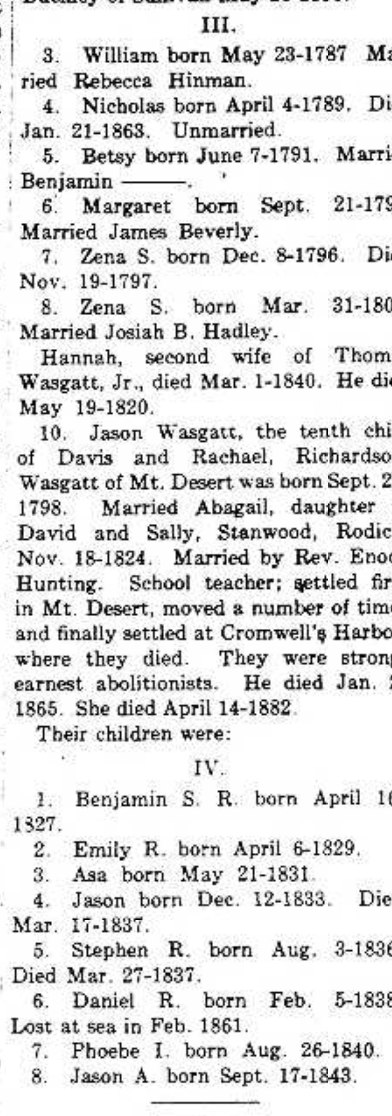
Jason and Abby buried two infant sons named after themselves and their fathers — the first Jason, born December 1833, dead at three; Stephen R., born August 1836, dead seven months later in March 1837. They lost another, Daniel R., at sea in February 1861, on the eve of the war that would take the eldest. By the time Jason died on January 2, 1866, of the eight children listed in the family record, four had predeceased him. Abby outlived him by sixteen years. They lie together at Mount Desert Street.
The genealogy's small phrase — strong, earnest abolitionists — is the load-bearing one. Almost nothing else in this story makes sense without it.
The boy next door
Their eldest, Benjamin Stanwood Read Wasgatt — called Benji — was born April 1827. In the 1850 census he is twenty-three, a seaman, still living at home with his parents and five siblings. Next door lived the Rodicks: Daniel and Deborah (Stanwood) Rodick and their twelve children. One of the daughters, Eunice, born October 1828, was Abby Rodick Wasgatt's niece. Eunice and Benji were first cousins.
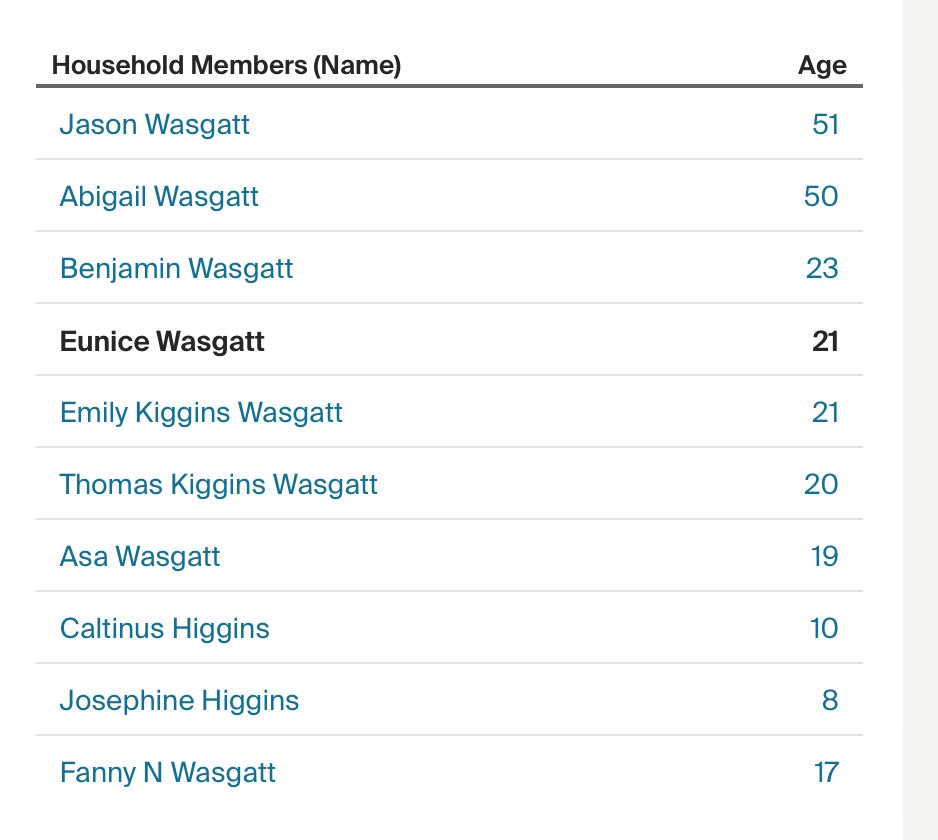
The Rodicks lived close enough that, in 1850, a boy of eighteen named William Richards is in their household. He will become important much later.
By 1860 Benji and Eunice were in their own household, just the two of them, ages thirty and twenty-eight. He is a fisherman. They have been married eleven years and have no children.
A boy named for Colonel Ellsworth
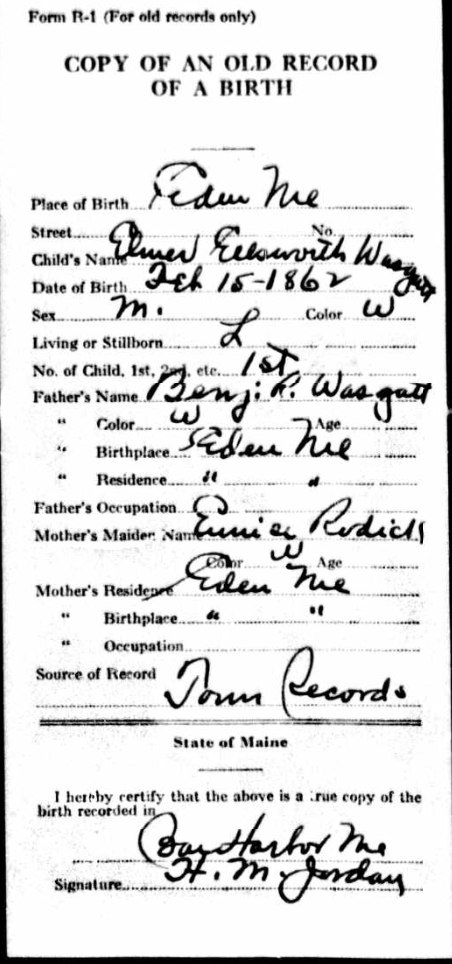
On February 15, 1862, their first child was born. He was twelve years into their marriage; she was thirty-three; he was thirty-four. They named him Elmer Ellsworth Wasgatt.
Colonel Elmer Ephraim Ellsworth — drillmaster, friend of Lincoln, the dashing twenty-four-year-old organizer of the Fire Zouaves — had been shot dead on the staircase of the Marshall House hotel in Alexandria, Virginia, on May 24, 1861, while pulling down a Confederate flag. He was the first conspicuous Union officer killed in the war. Lincoln wept; lithographs of him went up in parlors across the North; "Remember Ellsworth" became a rallying cry; the next year saw a wave of boys christened in his name. The Wasgatts' son was one of them. The child was born less than nine months after the colonel's death, six months after the Union rout at Bull Run, in a household whose grandparents the genealogist had thought to describe as strong, earnest abolitionists. The name was a vow.
Enlisted at thirty-five
The vow was kept. On October 11, 1862, when Elmer was eight months old, Benji enlisted. He went into Company E of the 26th Maine Infantry, a regiment raised in Bangor for nine months' service. The 26th left Maine for Washington on October 26, then sailed for New Orleans on December 2. He was a corporal.
The 26th's war was not the war one imagines. Of the one hundred and sixty-five men the regiment lost in nine months of service, thirty-four were killed or mortally wounded in action; one hundred and thirty-one died of disease. They served in the defenses of Washington, then in Louisiana — the Bayou Teche campaign in April 1863, the Battle of Irish Bend, the long forced supply-train march from Alexandria to Brashear City, the siege of Port Hudson. The official regimental history of Company E carried his death this way:
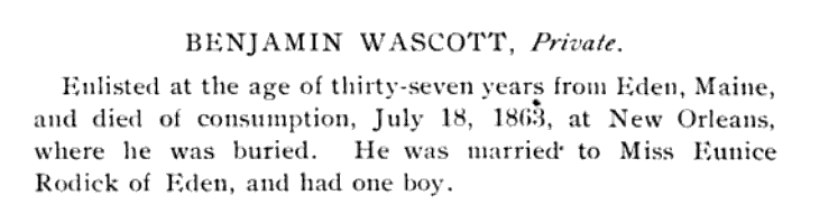
The Chalmette burial register, kept at the cemetery itself, records him more precisely: Wasgadd B R, Cor[poral], Co. E 26 [Maine], May 10 [1863], Marine [Hospital], New Orleans, Debility. "Debility" was a nineteenth-century medical word for the kind of progressive wasting illness that killed men in army hospitals by the tens of thousands — chronic dysentery, fevers, malaria, tuberculosis, malnutrition, whatever the doctor could not name. He had been in the army seven months. He had never seen his son walk.
![Cropped detail from a handwritten Civil War burial register at Chalmette National Cemetery, Louisiana. Visible is the entry: 'Wasgadd B R Cor[poral] E 26 [Maine] May 10 [1863] Marine [Hospital] N. O[rleans] Alexander, Debility, J. Bockee S2.' Surrounding entries record other Union deaths in May 1863 from diphtheria, amputation, acute diarrhoea, typhoid, and vulnus sclopeticum.](/residents/images/wasgatt-family/chalmette-burial-register-wasgatt.jpg)
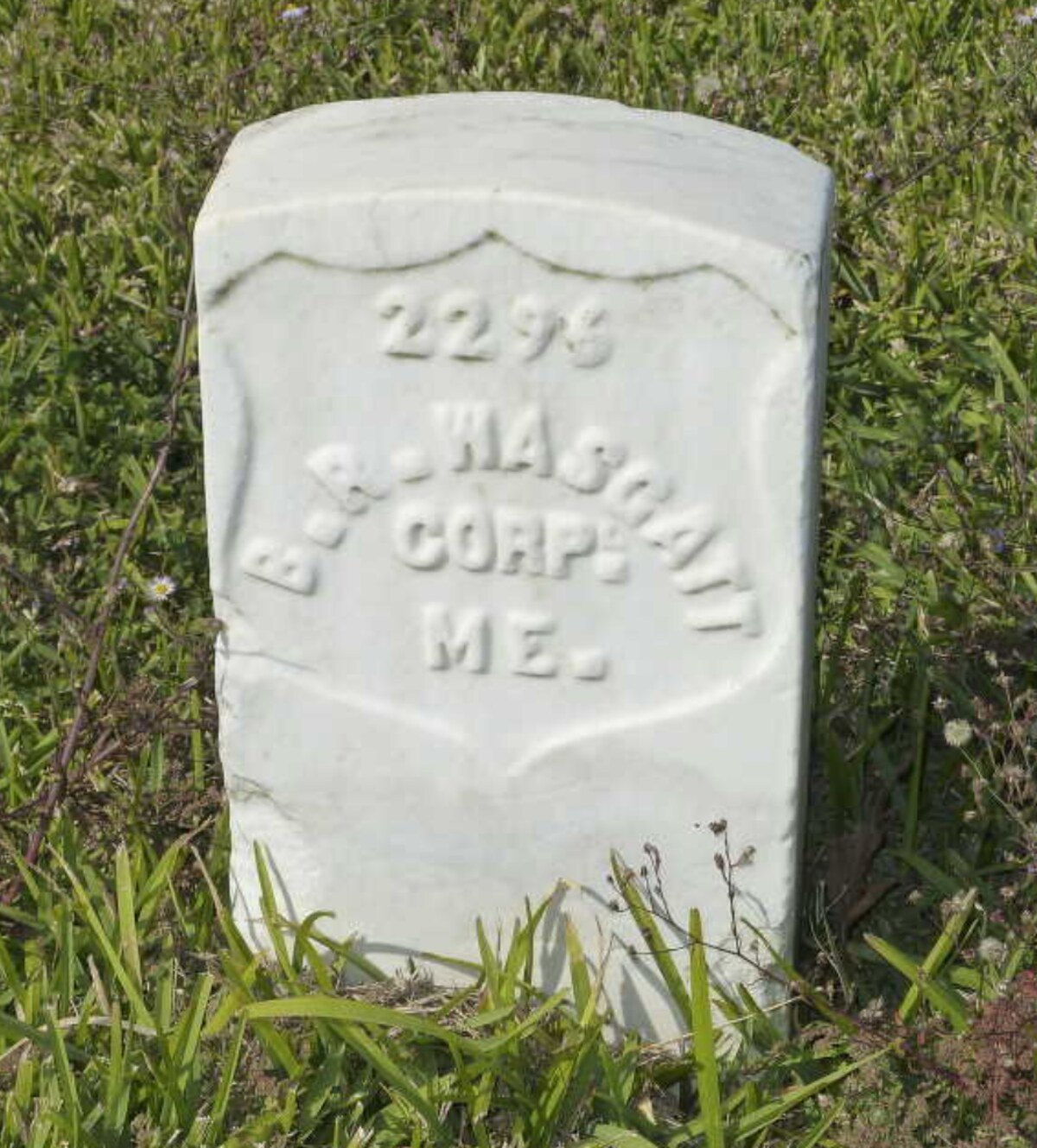
He was buried in Chalmette, in the new national cemetery the army was making for its dead on a former plantation outside the city. He lies there still, under a small stone marked 2298:
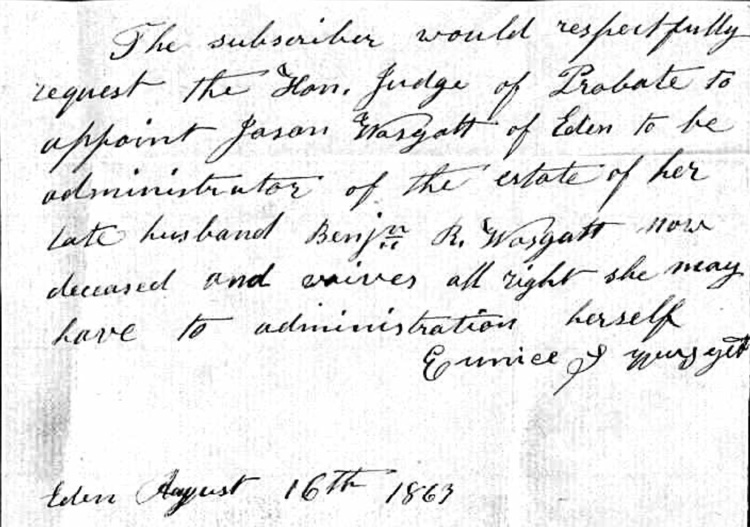
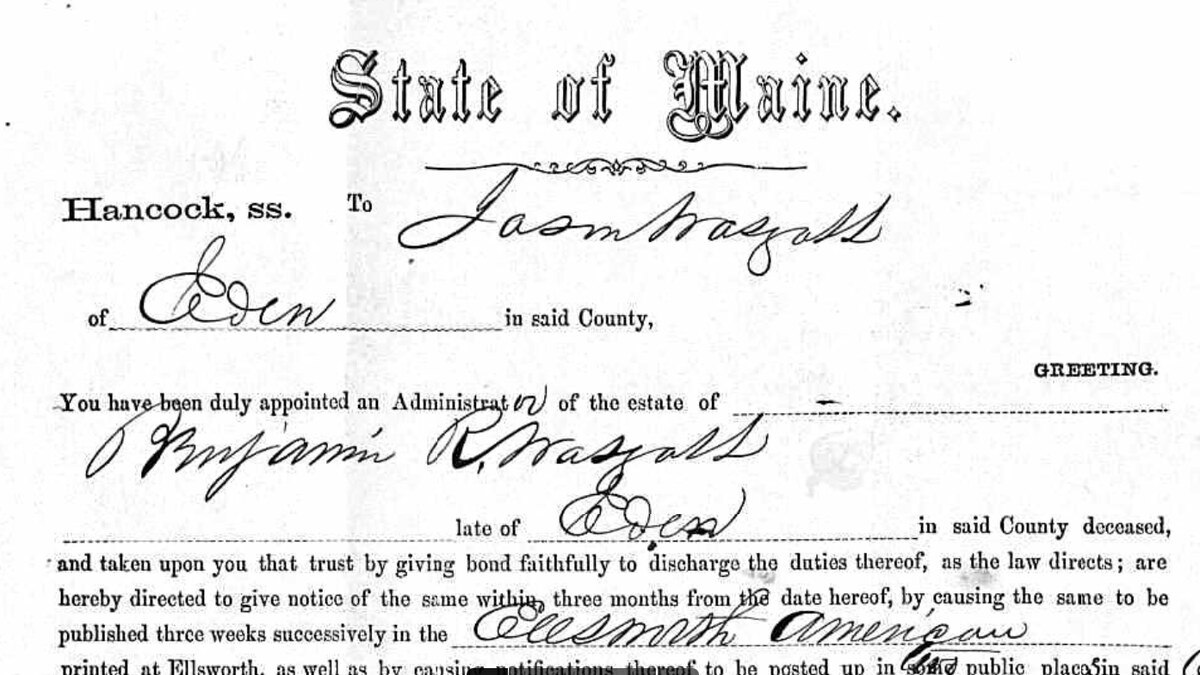
Back in Eden the courts appointed his father administrator of his small estate, at Eunice's request. She had written to the Judge of Probate on August 16, 1863, three months after Benji's death:
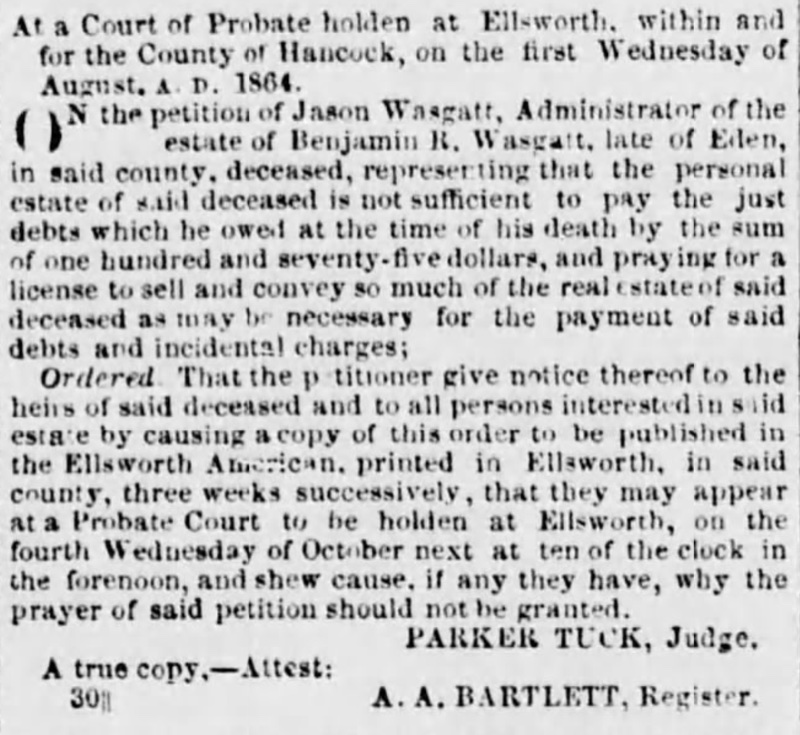
The estate was insolvent. A year after the appointment, Jason was back before the Hancock County Probate Court asking permission to sell off real estate to cover what Benji owed:
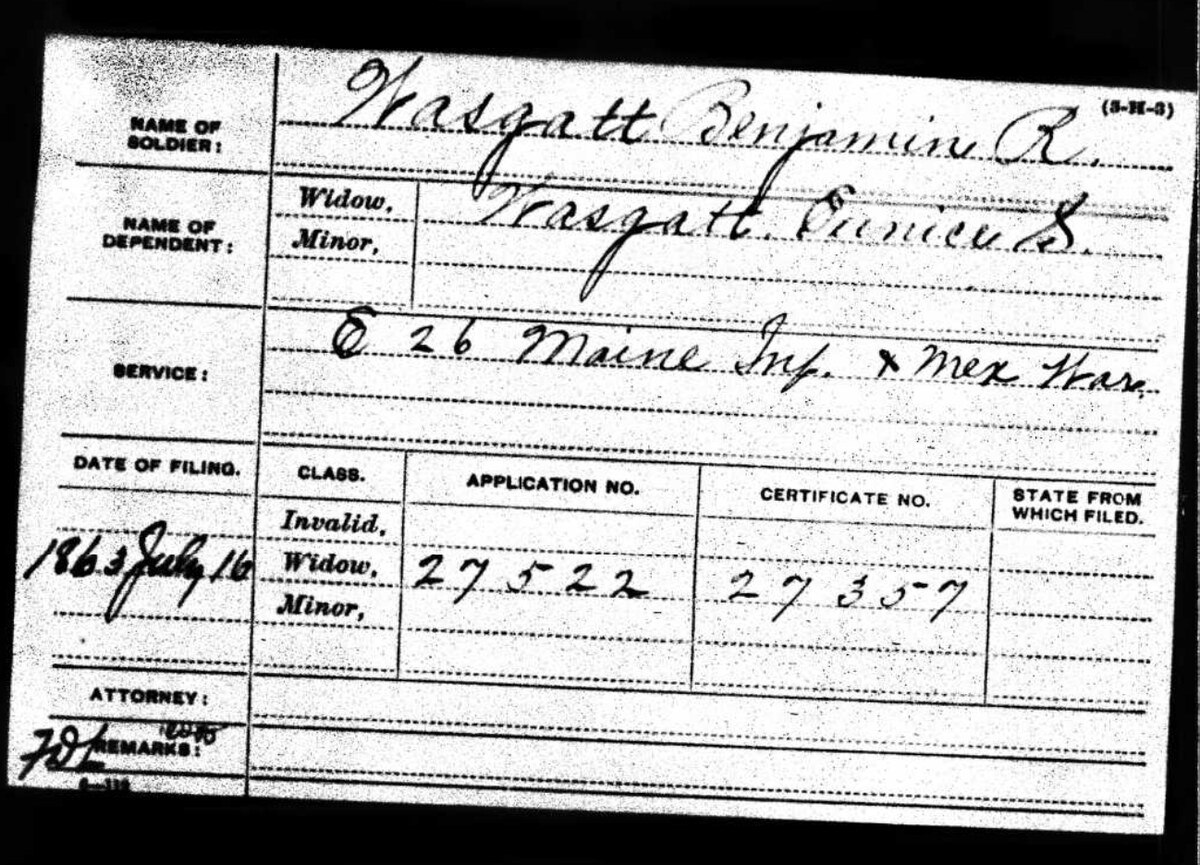
Eunice filed for her widow's pension in Augusta on July 16, 1863, two months after Benji's death and a thousand miles from his grave. The original application carries the cryptic notation "& Mex War" — Benji had apparently also served briefly in the Mexican War, in his teens. The pension was approved; certificate 27357 was issued.
The widow and the boy
For the next four years Eunice raised her son alone. In 1867 she remarried. The man was William Richards. He had grown up in the household next door to her parents — he was the eighteen-year-old in the Rodick neighbors' census line in 1850, when she and Benji were just married. By 1867 he was thirty-five, a cod fisherman; she was thirty-eight. The marriage to a Union widow forfeited her pension under the law as it then stood; she was no longer a soldier's widow but a fisherman's wife.
In 1870 the household is William Richards, 36; Eunice Richards, 28 (she was actually 41 — someone, presumably Eunice, had subtracted thirteen years); and Elmer Wasgatt, 8.
Elmer
The boy lived to fifteen years, seven months, and fifteen days. He died at the Richards house in Eden on September 30, 1877. The death record gives no cause.
![Handwritten copy of an old record of a death. Place of Death: Eden. Name: Elmer Ellsworth Wasgatt. Sex: M, Color: W, Single. Date of Birth: 1862 Feb 15. Age: 15 years, 7 months, 15 days. Place of Birth: Eden, Me. Name of Father: Benj. R. Wasgatt. Birthplace of Father: Eden, Me. Maiden Name of Mother: Eunice Rodick. Birthplace of Mother: Eden, Me. Date of Death: 1877 Sept 30. Cause of Death: [blank].](/residents/images/wasgatt-family/elmer-death-record-1877.jpg)
He is buried at Mount Desert Street under a small stone with his name and his dates.
Home again
The second marriage did not last in the ordinary sense, though no divorce is recorded. By 1880 — three years after Elmer's death — Eunice was no longer living with William Richards. She was back at her father's house. The census-taker found Daniel Rodick, then 81 ("Father"); his daughter Eunice S. Richards, 52 ("Self / Head"); her unmarried sister Ellen Rodick, 34 ("Sister"); and Ellen's son Benjamin Rodick, 7 ("Nephew").
William Richards spent the rest of the 1880s drifting. In the 1880 census he is forty-nine, a "common laborer," boarding in another family's house. He died in Penobscot, Maine, in 1893, age sixty-three, of heart failure. He was still legally Eunice's husband; he was buried, the death record said, in Bar Harbor.
The pension that came thirty-eight years late
The Act of March 3, 1901 restored pension eligibility to the remarried widows of Union soldiers — provided their second husbands had died and they were "needy." Eunice had been widowed for the second time eight years already by then. On May 31, 1901, eleven weeks after the new law took effect, she filed.
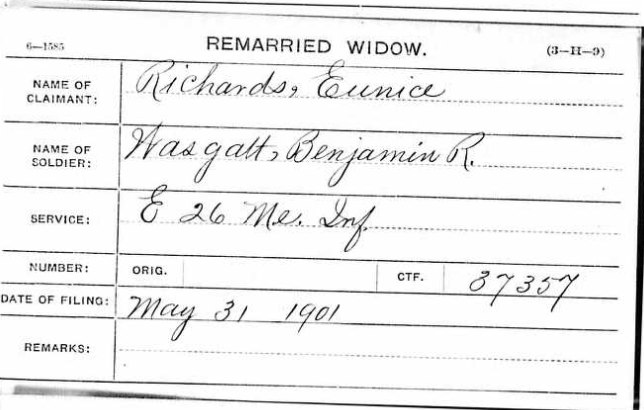
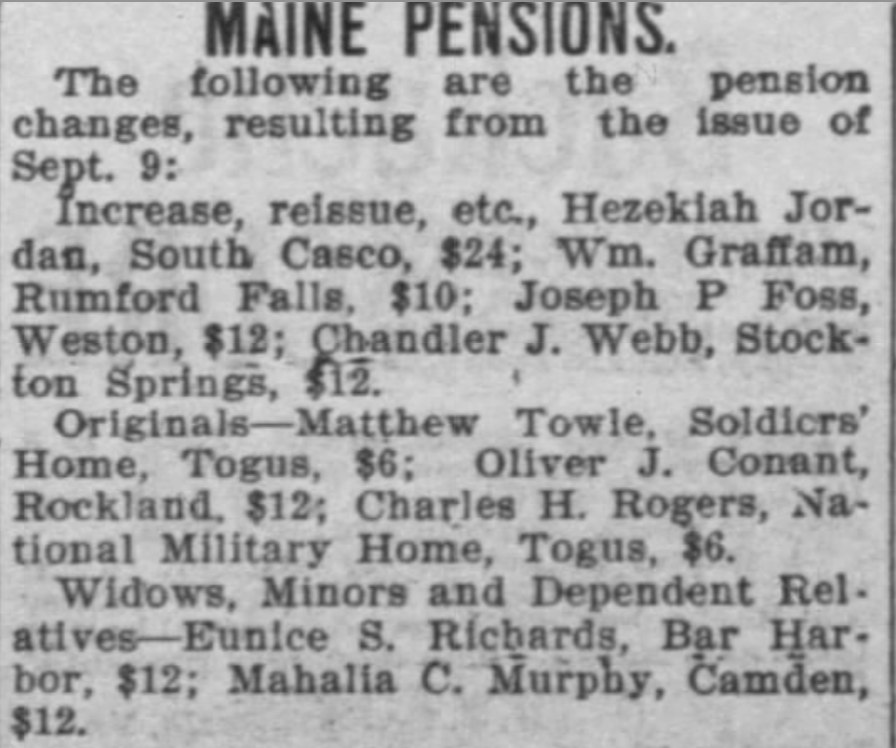
The award came through. In September 1902 the Bangor Daily News carried the routine notice among that month's pension changes:
The Wasgatt at Valley Cove
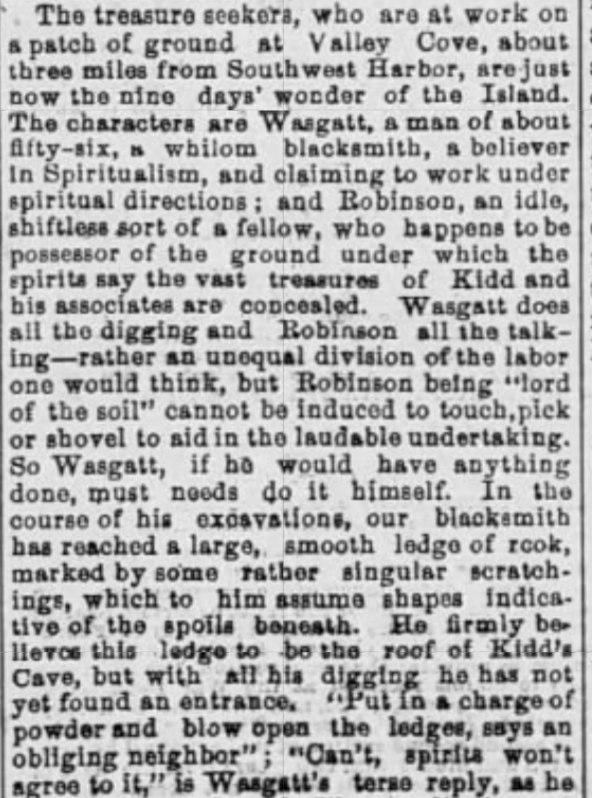
Somewhere in here, the family acquired its great eccentric. A Maine newspaper carried, in the late nineteenth century, an account of "the treasure seekers, who are at work on a patch of ground at Valley Cove, about three miles from Southwest Harbor." There were two of them — a Robinson, owner of the ground, who would not lift a shovel; and a Wasgatt:
… a man of about fifty-six, a whilom blacksmith, a believer in Spiritualism, and claiming to work under spiritual directions; … Wasgatt does all the digging and Robinson all the talking — rather an unequal division of the labor, one would think.
In the course of his excavations, our blacksmith has reached a large, smooth ledge of rock, marked by some rather singular scratchings, which to him assume shapes indicative of the spoils beneath. He firmly believes this ledge to be the roof of Kidd's Cave, but with all his digging he has not yet found an entrance. "Put in a charge of powder and blow open the ledges," says an obliging neighbor; "Can't, spirits won't agree to it," is Wasgatt's terse reply.
Twenty years before the Rodick brothers went down into the snake-filled cave on Bald Porcupine looking for Kidd's chains and anchors, a Wasgatt who had married into the same family was digging — slowly, by hand, under spiritual instruction — into a hill at Valley Cove. The Captain Kidd legend was the great background noise of nineteenth-century coastal Maine. The Wasgatts and the Rodicks both ran on it.
Eunice's last years
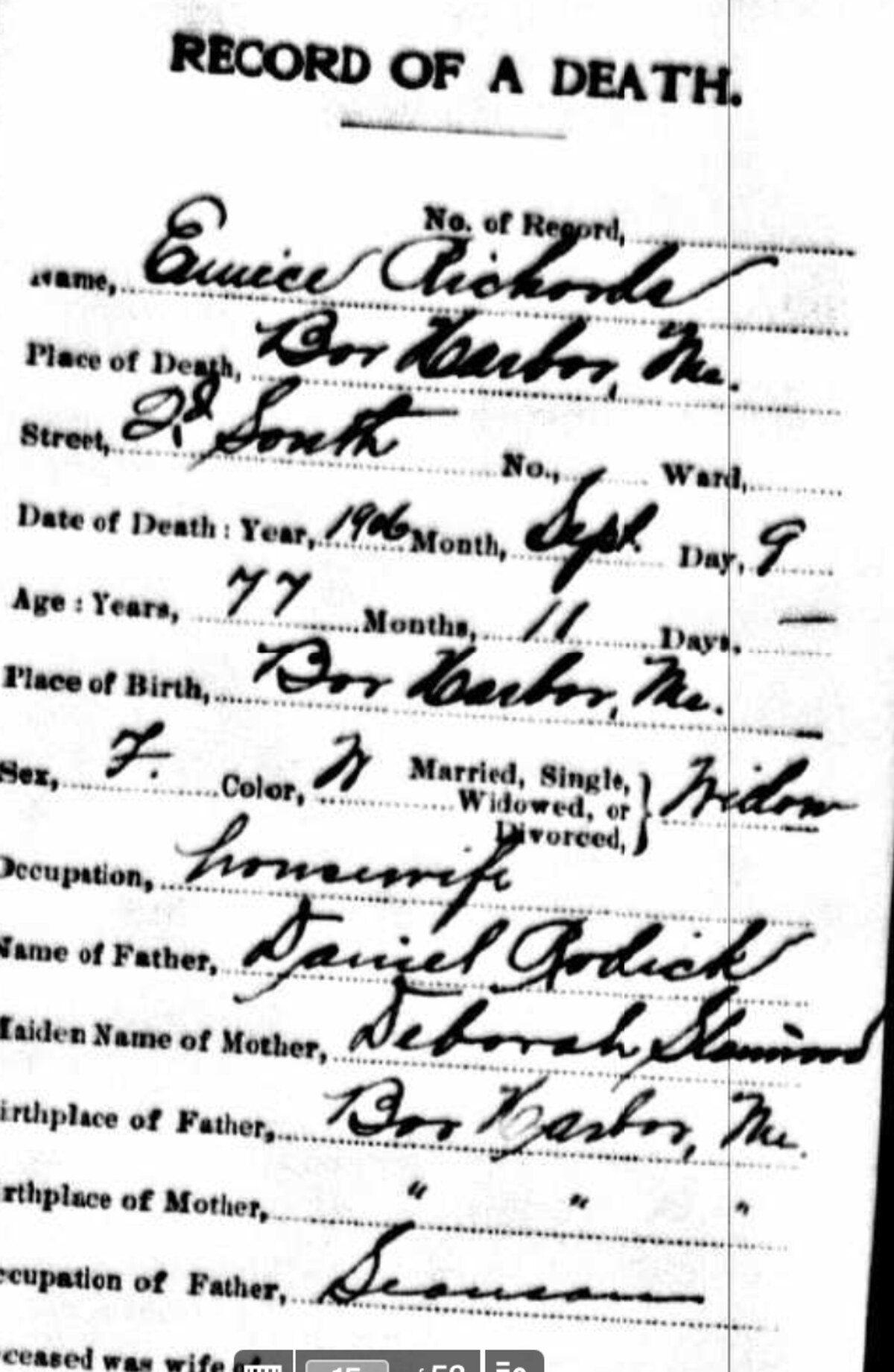
Eunice lived on at her father's old house on Second South Street in Bar Harbor. By 1900 her unmarried sister Ellen had married late and had a grown son, Benjamin Rodick; Ellen and her son and her son's wife Lida (Goodale) Rodick and Eunice — sister, son-in-law, niece-by-marriage, and the seventy-two-year-old widow — were under one roof. Eunice died there on September 9, 1906, at seventy-seven years and eleven months, of causes the clerk did not record. The death record lists her as Eunice Richards; her occupation as housewife; her father, Daniel Rodick; her mother, Deborah Stanwood; both born in Bar Harbor. Her father had been a seaman.
What is here
At Mount Desert Street: Jason and Abby Wasgatt, the abolitionist schoolteacher and his wife, together; the cenotaph for Benji ("B.R., Corporal, Co. E, 26th Maine Regiment," no dates) whose body is in Louisiana; Elmer Ellsworth Wasgatt, who lived fifteen years and seven months; and the infant daughter of a "Mr. and Mrs. W.H.," dead the day after she was born in December of 1885 or so, the stone broken at the top and the year unreadable. Eunice lies with her father, under her maiden name.
Eunice (Rodick) Wasgatt Richards is buried among the Rodicks. So is her sister Ellen, her father Daniel, her grandmother Deborah, and the rest. See The Rodicks.