Beginnings
The first Rodick on Mount Desert Island was Daniel — a man from Harpswell who, in 1764, married a Hamor girl named Betty and, in 1769, brought her east to Frenchman's Bay. In 1789 he was one of 108 men who signed the oath of allegiance to Massachusetts. He took up land on the island that lies opposite Bar Harbor at low tide and is cut off at high — the island still called Bar Island, but in old papers and old memory called Rodick's Island.
For three generations the Rodicks lived there as a farming and fishing family of the ordinary, working kind. They raised sheep. They ran a weir for bait fish, and ran a flag up the highest point of the island to tell passing fishermen the bait was in. They built a smokehouse for the catch, with metal rails to cart the fish from the shore. Mrs. Rodick, late into the century when the family already owned the largest hotel in Maine, was still spinning and weaving wool from her own sheep — because, as a contemporary writer noted, "like most families in Eden, [she] had always made good use of what lay to hand. Mr. and Mrs. Rodick knew how to do these things, and did them."
This is the background the rest of the story sits on. The Rodicks were not summer people. They were not cottagers, not rusticators, not Vanderbilts. They were the family who happened to be there when Bar Harbor became Bar Harbor, and the family who happened to own most of it.
Daniel's hotel
The patriarch's grandson, also Daniel — born September 1798, a farmer and fisherman who had settled at Cromwell's Harbor with his wife Deborah Wasgatt Stanwood — began in 1855 to take in lodgers in two cottages on Main Street. By 1866 he had converted the cottages into a small hotel. He called it the Rodick House.
The timing was good. Tobias Roberts had just built the steamboat wharf adjacent to his Agamont House, and the Eastern Railway started running steamers in. The "rusticators" — artists and their patrons who had been coming since the 1840s and putting up at any farmhouse that would take them — were giving way to a different sort of visitor: families, leisure-class families from Boston and New York and Philadelphia, who wanted to spend the whole summer. The Rodicks, like the Higginses and the Lynams, found themselves running hotels.
The Rodick House grew. Wings were added in 1870, 1875, and 1882. In November 1881 seventy carpenters began work on the final expansion. When they were done it was — the advertisements said, and they were right — the largest hotel in Maine. Four hundred sleeping rooms. Halls and dining hall accommodating one thousand persons. A wrap-around porch five hundred feet long and twenty-five feet deep. A lobby so full of unsupervised young women in summer that it was famous across the country as "the Fish Pond," where, the joke went, the girls came to fish for husbands. At its peak the hotel held six hundred guests, served seven hundred and fifty at meals, and drew three thousand to its twice-a-week dances. It took a hundred and eighty people to run it.
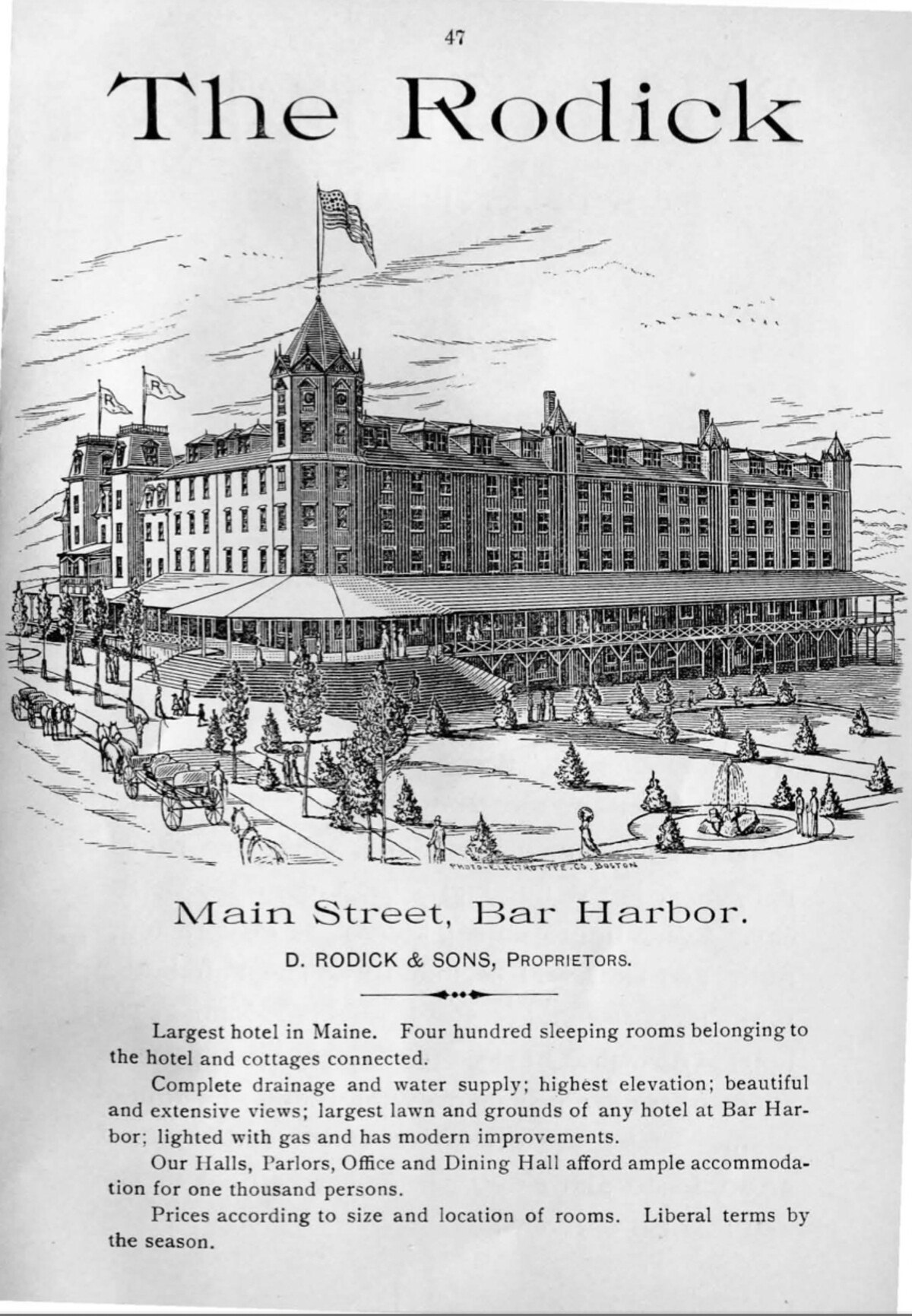
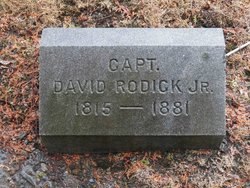
By the mid-eighties the proprietors signed themselves "D. Rodick & Sons." Daniel had died in 1880; the running of the place was passing to his nephew Capt. David Rodick Jr. (1815–1881), and to David's sons — Fountain, Serenus, Milton, and Edward. They were the next generation: the Rodicks who would actually preside over Bar Harbor's golden age, and outlive it.
Marian, and what was lost early
David Jr.'s first marriage gave him four children — Fountain, Serenus, Flora, and a boy named Milton. The boy died in November 1852 at six months old. His mother, Marian L., died three months later, in February 1853, at thirty-five. She is buried at Mount Desert Street with her infant son under a stone now nearly illegible.
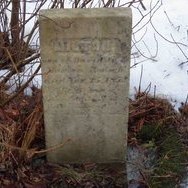
David Jr. remarried; he and his second wife had Milton (the second of that name, born 1857) and Edward. Fountain, the eldest, was nine when his mother died. He was, by every later account, the practical mind among the Rodick children — the planner, the manager, the engineer; the one who would learn whatever he needed to know by doing it himself, and who would mistrust on principle anyone he had to pay to do it for him. It is tempting to see in him the eldest son of a young family who lost its center.
Saving the resort
In the summer of 1873 typhoid struck the Bay View House. Eight lodgers fell sick at the hotel; five more were diagnosed back home; thirteen guests are recorded as having died. At about the same time scarlatina — a milder form of scarlet fever — closed the Rodick House. Both hotels shut. Tourists fled the village. A Boston doctor's report, picked up by newspapers across the country, suggested that Bar Harbor itself was unhealthy. Some commentators noted that the name "Mount Desert" might prove a prophecy.
It was a crisis the resort might not have survived. In January 1874, David, Fountain, John A., and Serenus Rodick, together with four Higginses, Alfred Conners, and Edwin "Ely" Des Isles, petitioned the legislature to charter the Bar Harbor Water Company. The act passed on February 10. The charter members held their first meeting at the Rodick House on February 23; the company would meet there for the next twenty years.
The work moved at a speed that is hard to fathom now. Construction of an aqueduct, a reservoir on Scott's Hill, and the distribution pipes began on May 10. The system was dedicated on July 4. By mid-July — sixty-five days after the first shovel — every hotel and cottage in Bar Harbor had piped water from Duck Brook. Ely Des Isles, who had learned to build flumes in western placer mines, designed the wooden sluices. Fountain Rodick was on the Building Committee. By his own later testimony, he was principally responsible for the system's design and refinement over the next twenty years.
Almost half a century later, an old judge being interviewed by a Bar Harbor reporter remembered exactly how it had happened — the threat of an epidemic, the men who absolutely would not entertain the possibility of failure, the trestle near Forest Street, the boxes built and sunk, the dam, the reservoirs, the day the water was first turned on and "the force permitted it to be thrown 30 feet in air."
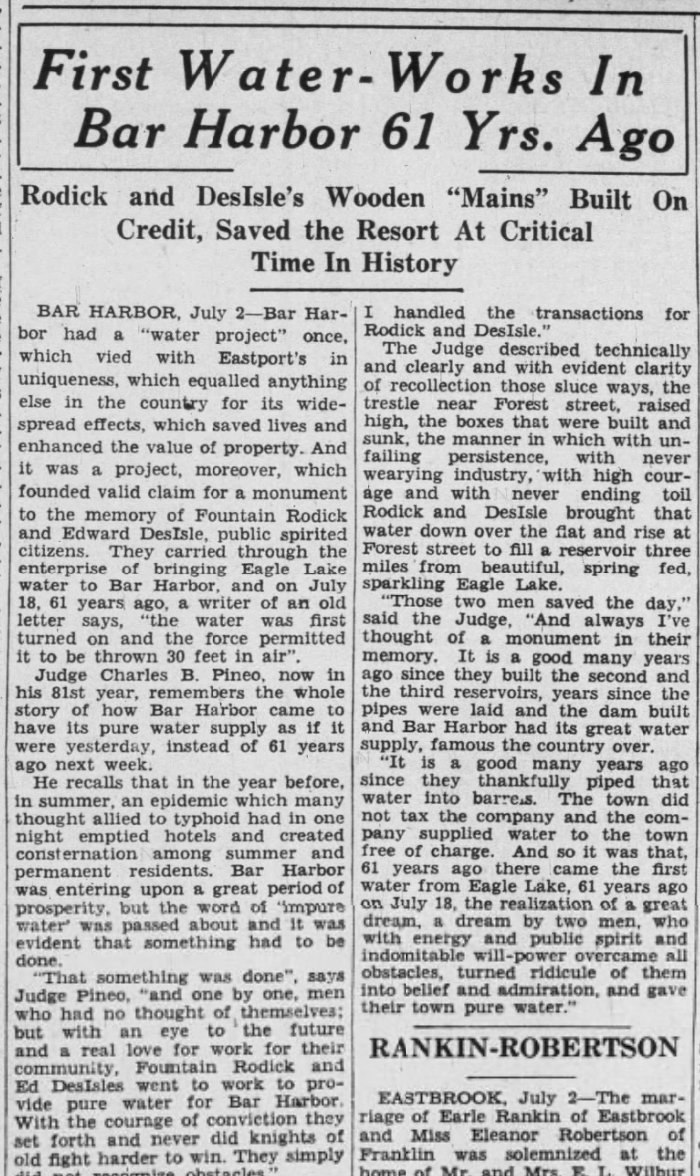
"Those two men saved the day," said the Judge, "and always I've thought of a monument in their memory. … 61 years ago there came the first water from Eagle Lake … the realization of a great dream, a dream by two men, who with energy and public spirit and indomitable will-power overcame all obstacles, turned ridicule of them into belief and admiration, and gave their town pure water."
— Judge Charles B. Pineo, on Fountain Rodick and Edward DesIsle
That is the legend. The reality, well documented in the company's own records, is more complicated; it includes shareholders disgusted with assessments rather than dividends, customers furious about low water pressure and eels in their pipes, and a man named Elihu Hamor who threatened to start a competing water company. But the central fact is right: Fountain Rodick spent twenty years rebuilding and re-rebuilding that system. By the time he was done with it the wooden flumes had been replaced with twelve- and sixteen- and twenty-four-inch iron pipes; the original reservoir had been abandoned for one higher up Cunningham's Hill, which had in turn been abandoned for a new dam complex at New Mills Meadow; and the company drew directly from Eagle Lake. That is the system that — with only modest changes — still supplies Bar Harbor today.
A queer cave on Bald Porcupine
In January 1896 the New York papers picked up a story so strange that The Sun ran it on a full column under the headline IT IS A QUEER CAVE.
Two men of Bar Harbor — Harvey Hodgkins and Erl Bunker — had been strolling on Bald Porcupine, the uninhabited sheep-island off Frenchman's Bay, when they noticed a dark spot in the cliff. Bunker let himself down a dozen feet, and reported back that the passage led into a big chamber, dark as night. They went back for torches and lanterns. They knew that men had been digging for Captain Kidd's buried treasure near Ellsworth, twenty miles away; they thought if the pirate had buried his wealth anywhere on the Maine coast, he could not have chosen a better place than the cave on Bald Porcupine, which guards the entrance of a harbor fitted by nature for a pirate's retreat.
What they found inside was a vaulted chamber fifty feet long and twenty feet high, the floor under a foot of oozing mud, water trickling through from the mountainside, a rust-eaten anchor, a chain that crumbled at a touch, hewn shelves of stone, and a passage leading off into the dark.
The secret leaked. The men consented to take a few friends to the spot.
In the party were Serenus Rodick, Milton Rodick and Fountain Rodick, the owners of Rodick or Bar Island, which lies near Bald Porcupine, and who know every spot on Frenchman's Bay. They were enjoined to secrecy and consented to share in the treasure equally.
— The Sun, New York, January 16, 1896
The party brought oilskins, long rubber boots, lanterns, torches, and firearms. They built a bonfire at the entrance of the cave. Inside, by the light of the bonfire and a half-dozen torches, they sank to their knees in slime and saw little scintillating glimmers on the walls — the eyes of snakes. Coiled in a corner was "a huge bunch of snakes of all colors and sizes." The men fired a volley from their revolvers; the article reports two hundred snakes in the bunch. Past the snakes one of the party stumbled across the rust-eaten anchor and chain. Past the anchor, Milton Rodick squeezed himself, against the protests of his brothers, through a narrow passage that dropped down a steep hole — and from which he was compelled to retreat.
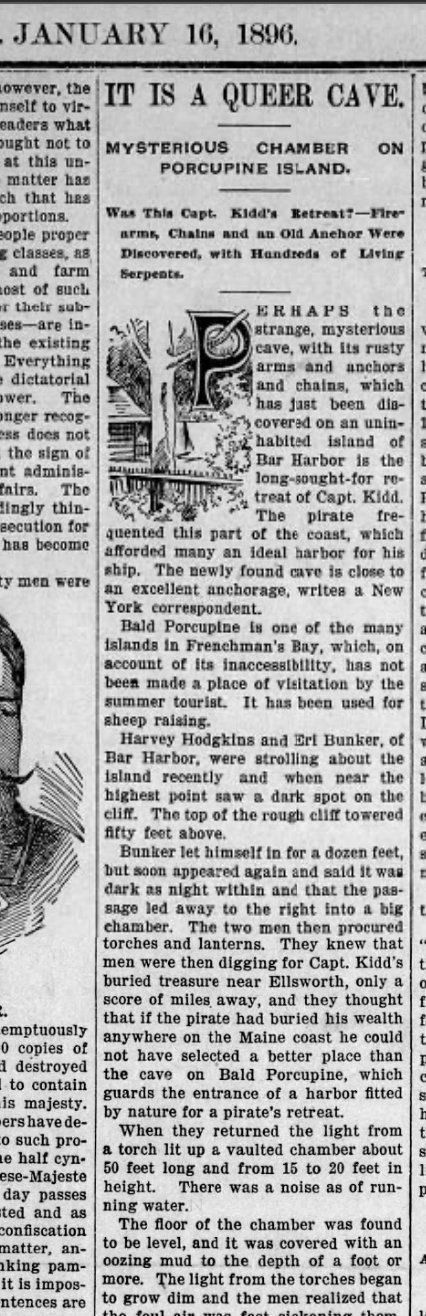
No treasure was ever produced. The cave is, in fact, a sea cave, and the snakes — Maine has only the harmless garter and water snake — were no doubt over-counted by a journalist working from third-hand accounts. What the article preserves is something more interesting: a single afternoon in 1896 in which the three Rodick brothers, owners of Bar Island and of more than half of downtown Bar Harbor by then, went hunting pirate gold on a sheep island with the matter-of-fact equipment of working men. Oilskins, lanterns, revolvers. They had been raised on these islands. They knew every spot.
Barbarians at the gate
The Rodicks ran the water company the way they ran everything else: on a handshake. Fountain and Serenus had become majority shareholders by 1881, when the other holders preferred to surrender their stock rather than be assessed for improvements; by 1882 the brothers and their siblings owned all thousand shares. They did not always call the legally required directors' meetings. Fountain himself acknowledged that he did not generally employ professional engineers, preferring to work out design solutions himself; his training, he said, came from "thirteen years of practical experience."
The summer people noticed. In a drought summer in 1886, a group of cottagers — David Ogden, S. E. Lyon, W. S. Gurnee, DeGrasse Fox, Morris K. Jesup, eventually James G. Blaine — called in a New York civil engineer named James T. Gardiner and concluded that the Rodicks were running the system incompetently. They organized a rival, the Eden Water Company, and went to the legislature for a charter. Blaine, the once-and-not-quite presidential candidate, gave testimony. The Eden men, ostensibly the wealthy outsiders, framed themselves as plucky shareholders against a Rodick monopoly.
The Rodicks marshalled witnesses, including Fountain himself, whose testimony ran across two days; the locally edited Mount Desert Herald took the brothers' side with some heat. The 1887 compromise sent the Eden Water Company away with a charter that would only take effect if they made a fresh purchase offer to the Rodicks. They didn't act. The Rodicks kept investing.
By November 1893 Fountain and Serenus, in personal debt secured against their shares in the company, had defaulted. In a single special meeting on November 21, the brothers' creditor handed control of the Bar Harbor Water Company to a new board — John S. Kennedy, David B. Ogden, William H. L. Lee of New York, Charles J. Morrill of Boston, and Fred C. Lynam of Bar Harbor. Within a year the new shareholders' list ran to twenty names, including George W. Vanderbilt and J. T. Woodward; nine of them had also held shares in the Eden Water Company. The two companies were quietly merged. The Rodicks were out.
One historian later cast it as a fight between full-time and part-time residents over the town's destiny. That is the right shape of it. The Rodicks had built the system that saved the resort, and they lost the system because the resort had outgrown them — because the people now summering at Bar Harbor expected a corporation, with directors and engineers and printed annual reports, and not two brothers running things out of the office at the Rodick House.
Fountain alone
Serenus died sometime in the early 1900s; Milton died in February 1913 at fifty-five; Edward died still earlier. Of the five children of David Jr., only Fountain and his sister Flora outlived the Gilded Age. Flora was on Bar Island, married to Judge Charles B. Pineo, who had handled the family's legal work and now spent his summers in the old Rodick farmhouse where his wife had grown up. Fountain had the hotel.
By the early 1900s the hotel was finished. The cottage era had taken the summer trade away; the place sat half-empty and out of date, and was finally closed in 1902. In 1906 the contents were sold at auction over the course of months, and the building came down. Fountain had been living in it, alone, for the previous ten years.
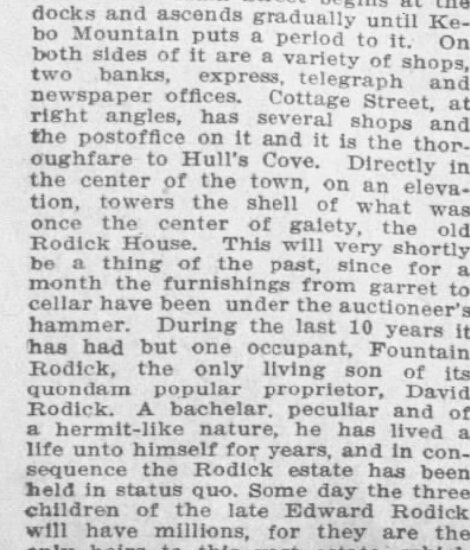
He never married. The Buffalo writer who described him called him peculiar; the same writer, walking the town she had not been to in years, was struck by the queer names of the residents — two grocers named Cough and Joy, a caterer named Chalk, an ice-cream seller named Peach, a chemist named Doe, a blacksmith named Heal, and an ice man, in a prohibition town, named Brewer. It was the same town Fountain had grown up in, and in some respects it had not changed at all.
What had changed was that he was alone in it. The Rodicks who had spread out over Bar Island, who had run the largest hotel in Maine and the water company and most of downtown, had reduced — through deaths and the absence of children — to Fountain in a closed hotel and Flora out on Bar Island. The "vast estate," as the Buffalo writer correctly observed, would all go eventually to the three children of his late brother Edward.
A small political note
Sometime in the early 1880s a Representative Rodick of Eden — the town had not yet renamed itself Bar Harbor — voted against re-establishing the gallows in Maine. Maine had abolished capital punishment in 1876; in 1883 a bill came up to restore it. Whoever it was — Fountain, Serenus, or perhaps another in the family — voted no, and a sympathetic paper noted it briefly:
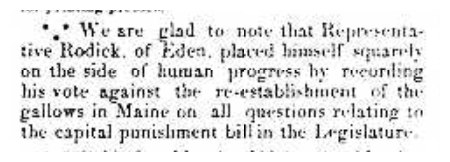
It is a small thing, but a particular one — a Rodick on record, in a state that was actively debating whether to bring back the rope, voting on the side of human progress.
The end of it
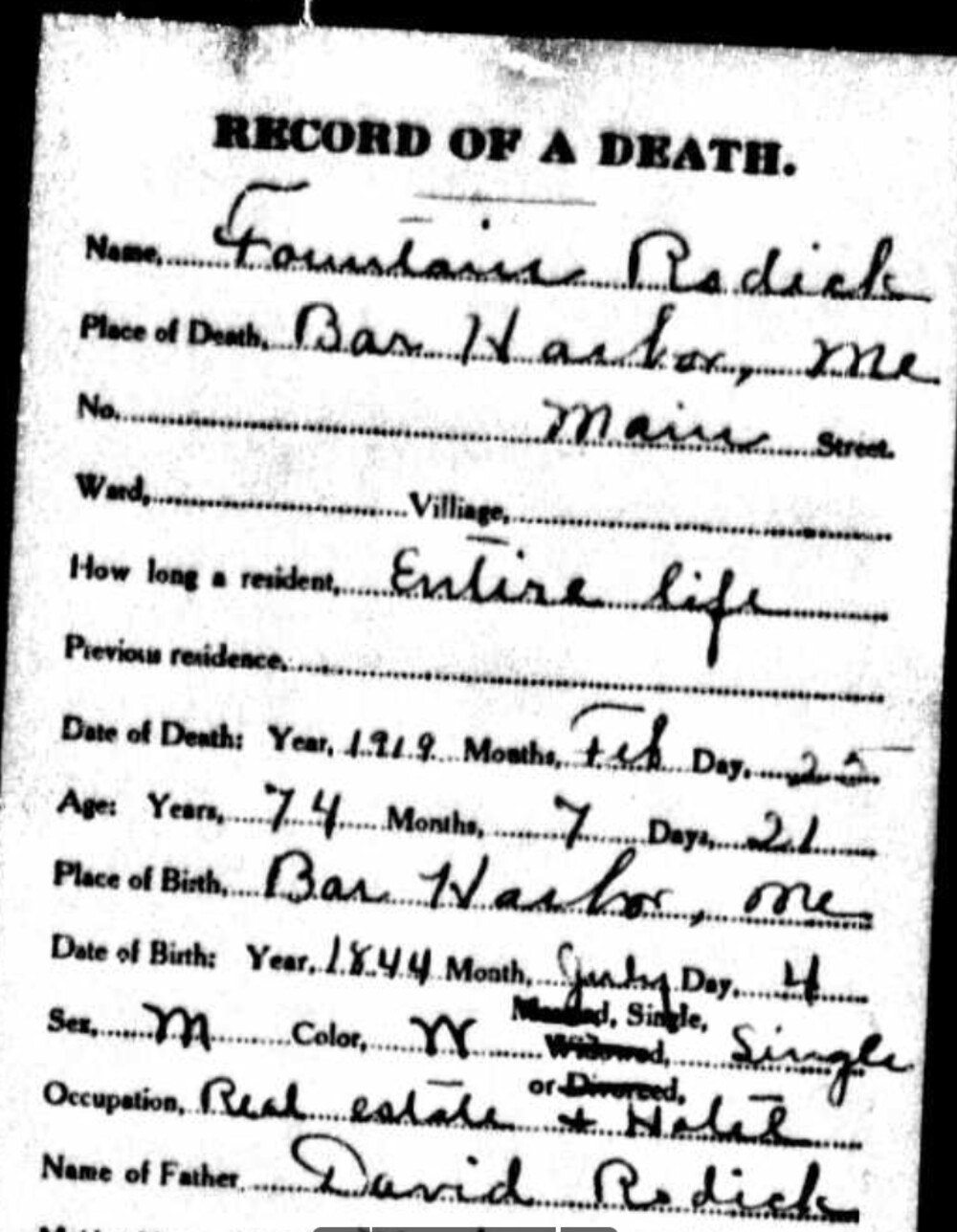
Fountain died at the Maine Street house, in Bar Harbor, on the 25th of February 1919, at seventy-four. His occupation was given as "Real estate & hotel," his marital status as Single. He had been a resident of Bar Harbor his entire life.
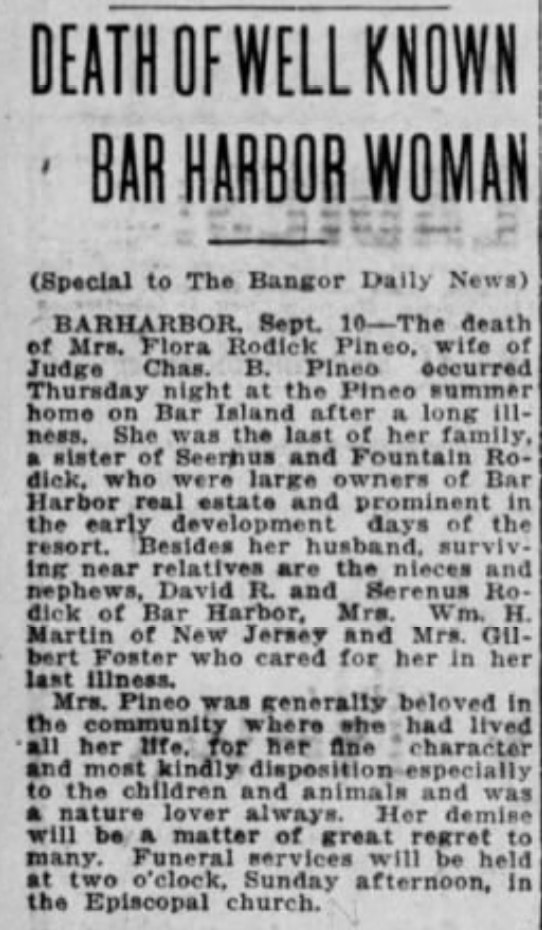
Flora outlived him. She and Judge Pineo continued to summer on Bar Island; the Rodicks had sold the middle third of the island in 1907 to Mrs. Mabel Hunt Slater, who built her cottage there, and in 1909 the western third to Edward T. Stotesbury, who would later sell it on to John D. Rockefeller Jr., who gave it to what became Acadia National Park. The family rolled their old farmhouse across to the eastern third and lived there. Flora died there, after a long illness, at the Pineo summer home — the obituary called her "the last of her family," and noted that the surviving near relations were her husband, her nieces and nephews, and Mrs. Gilbert Foster, who had cared for her in her last illness. "Mrs. Pineo was generally beloved in the community where she had lived all her life, for her fine character and most kindly disposition especially to the children and animals and was a nature lover always."
Capt. David Rodick Jr., the father of all of them, lies a few steps away, under a small flat stone marked with his rank and his dates only.
What's left
The hotel was torn down in 1906. The Rodick stake in the water company became a footnote in 1893. The eastern third of Bar Island stayed in the family longer than anything else; the rest of the island is in the national park. The Bar Harbor Grand Hotel on Main Street, built in 2003, is a deliberate architectural homage to the old Rodick House — a four-story wood-frame replica with cupolas and a wide veranda, on a parcel three blocks from the original. There is no monument to Fountain Rodick. Judge Pineo once said there ought to be.
The town's water still comes from Eagle Lake.