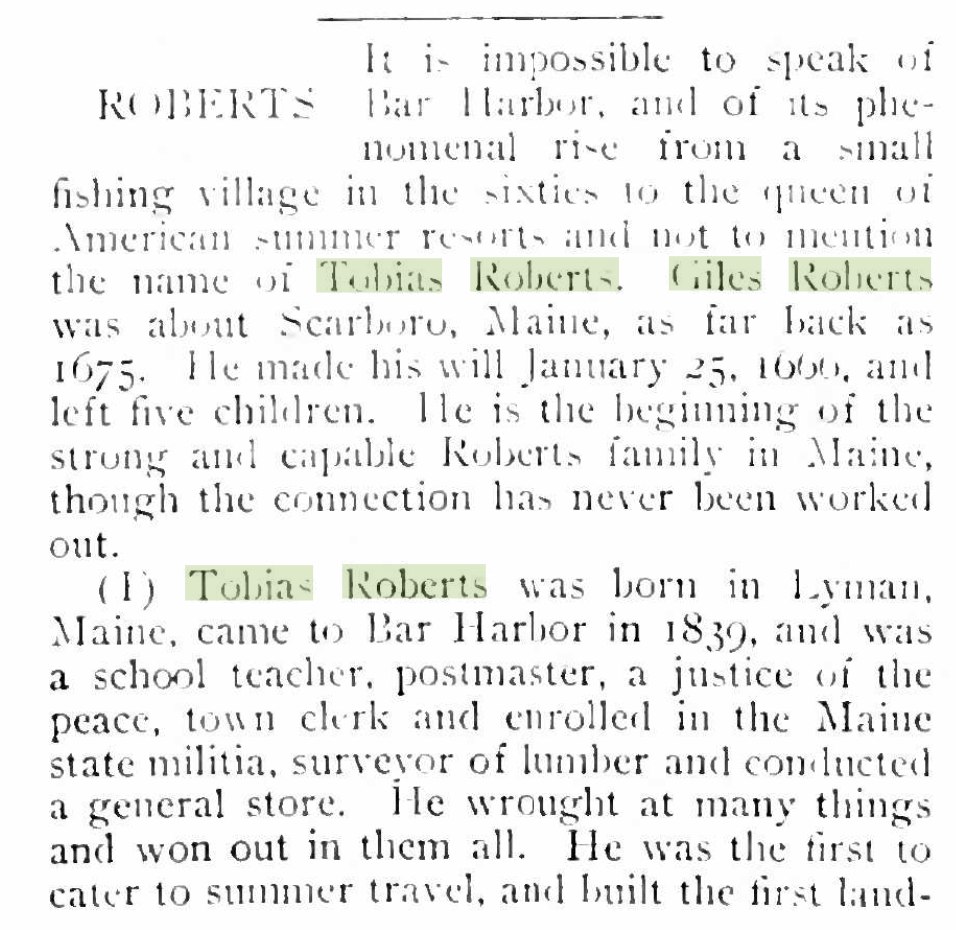
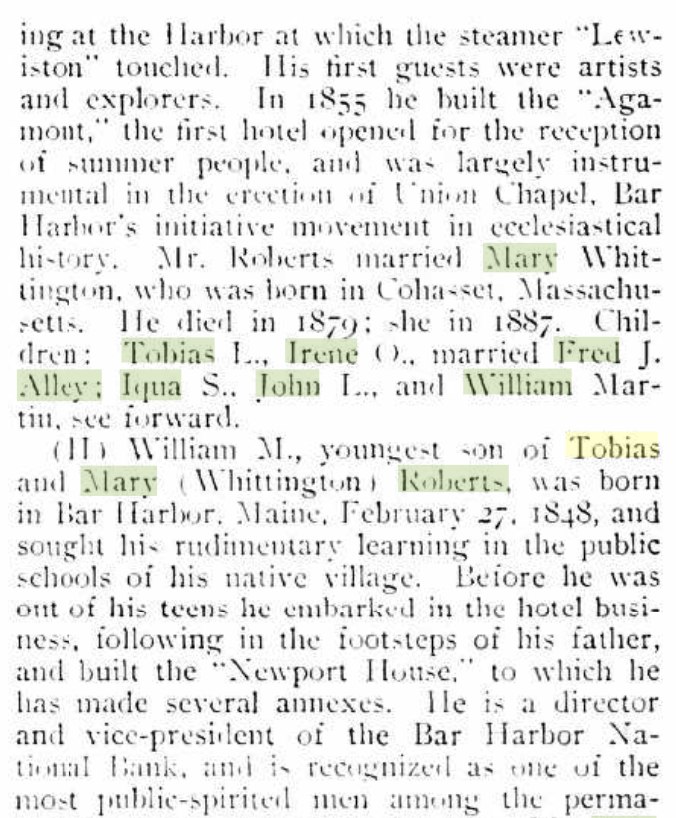
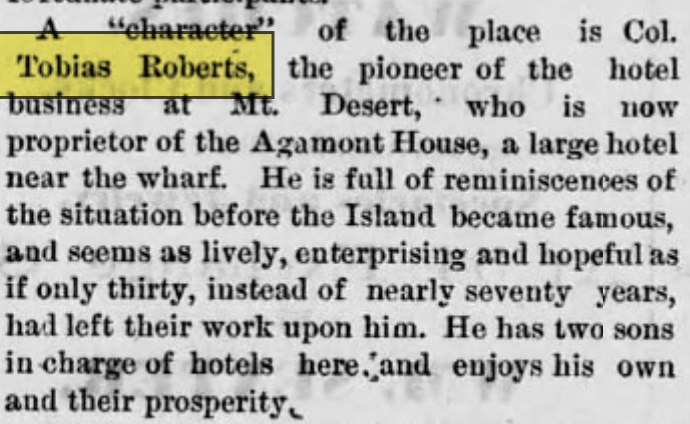
Tobias Roberts was not a Mount Desert Island man by birth. He was born in 1806 in Lyman, Maine — a small inland town in York County, two hundred miles southwest of Bar Harbor. He came to Eden in 1839, a twenty-something newcomer, and married the widow Mary Nichols, who had been born in Cohasset, Massachusetts. The line that became one of Bar Harbor's defining families began with two outsiders settling at the edge of a fishing village of fewer than a hundred souls.
An 1839 visitor to the area would have found a coast of cordwood and codfish. Eden was a working settlement of farmers and fishermen, with a few summer artists beginning to arrive from Boston and New York to paint the granite shoreline. Roberts taught school, served as postmaster, conducted a small retail country store, did some land surveying, sat on the superintending school committee, and was enrolled in the Maine state militia. A 1915 history of the family described him simply: "He wrought at many things and won out in them all."
The Agamont House (1855)
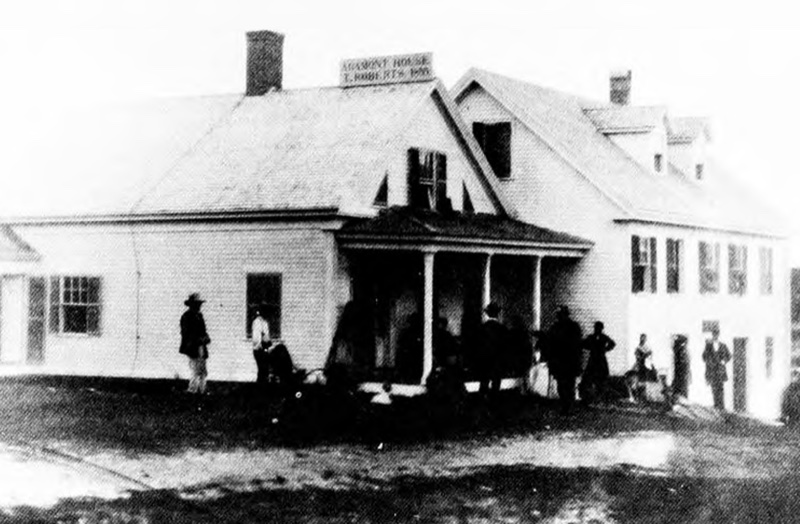
In 1855, Tobias Roberts converted a small wooden tavern at the head of what is now Agamont Park into a proper hotel. He called it the Agamont House. It was, by every contemporary account, the first hotel at Bar Harbor — predating the resort's tourist boom by roughly a decade and serving the first wave of "rusticators," the artists and writers who had begun riding the stage from Ellsworth to escape the polluted summers of New York and Boston.
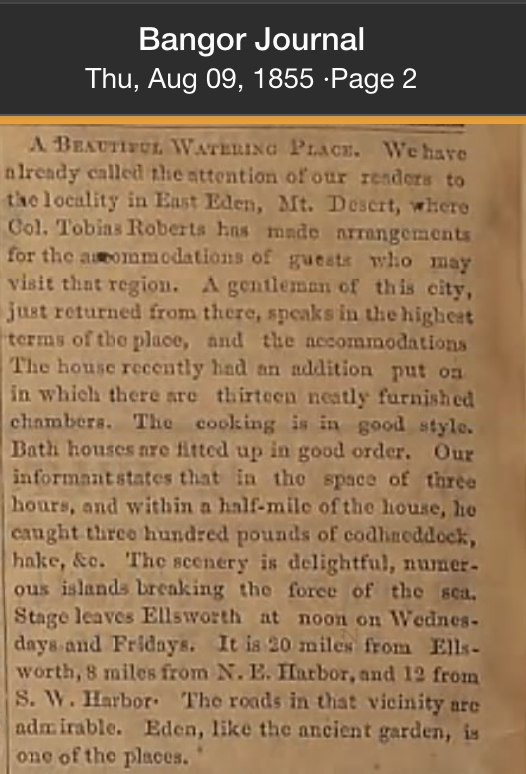
An August 1855 notice in the Bangor Journal recorded the early establishment: "Col. Tobias Roberts has made arrangements for the accommodation of guests who may visit that region… The house recently had an addition put on in which there are thirteen neatly furnished chambers. The cooking is in good style. Bath houses are fitted up in good order." Within three hours of the house, the article noted, an informant had caught three hundred pounds of cod, haddock, and hake.
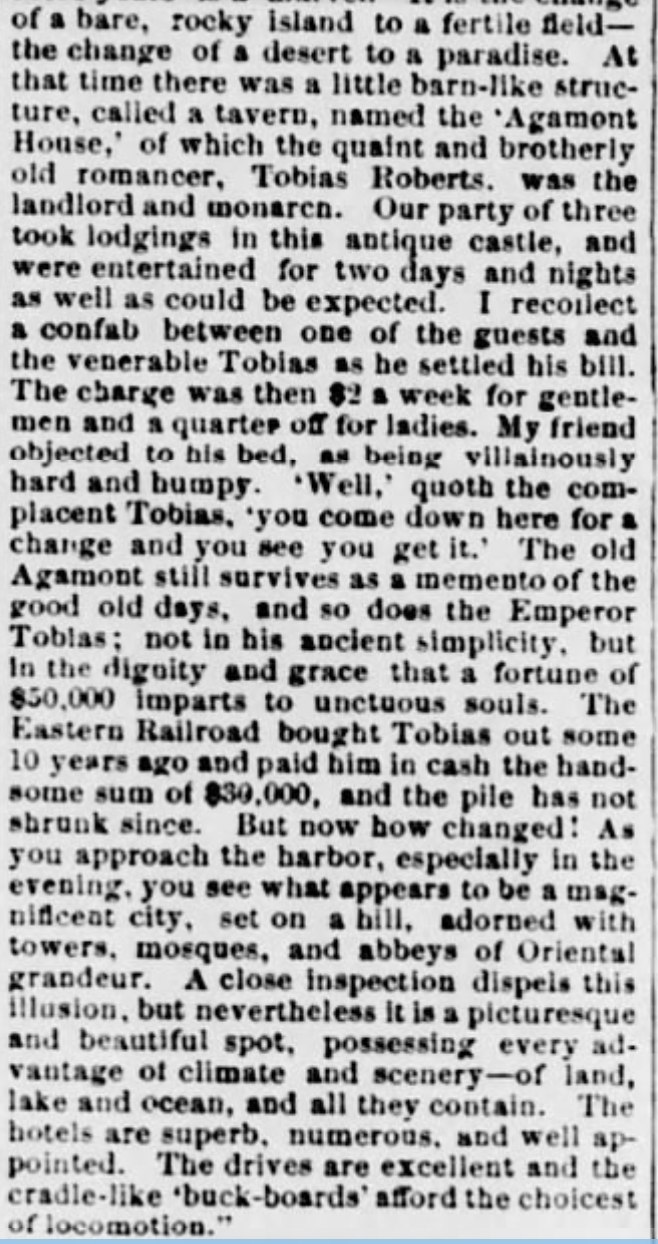
A later traveler — writing decades after his visit — gave a vivid description of the hotel in its earliest years: "a little barn-like structure, called a tavern, named the 'Agamont House,' of which the quaint and brotherly old romancer, Tobias Roberts, was the landlord and monarch." The charge, he recalled, was "$2 a week for gentlemen and a quarter off for ladies." A guest had complained that the beds were "villainously hard and bumpy." Tobias had replied: "Well, you come down here for a change and you see you get it."
The Wharf and the Steamboats
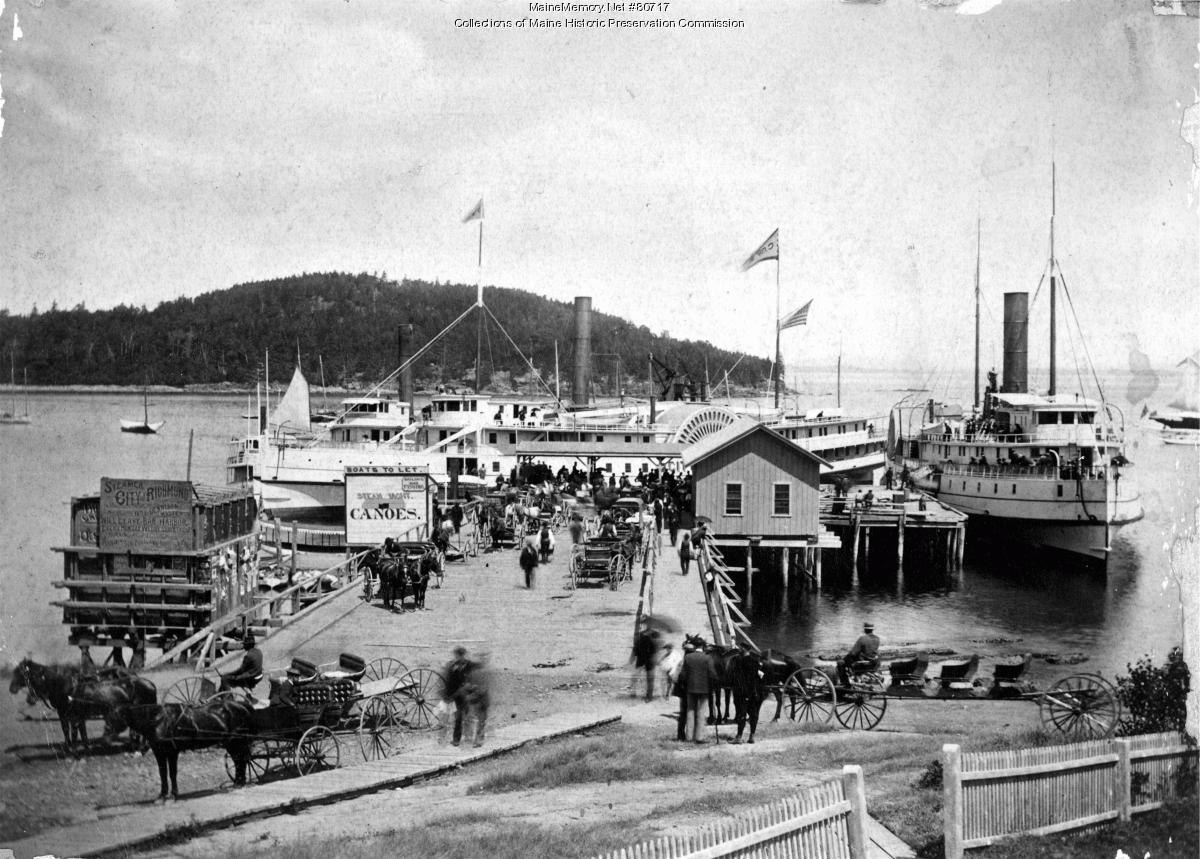
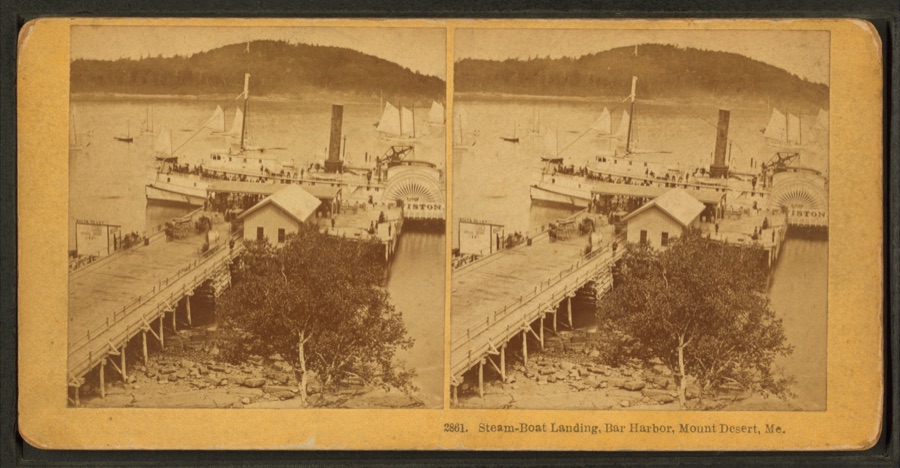
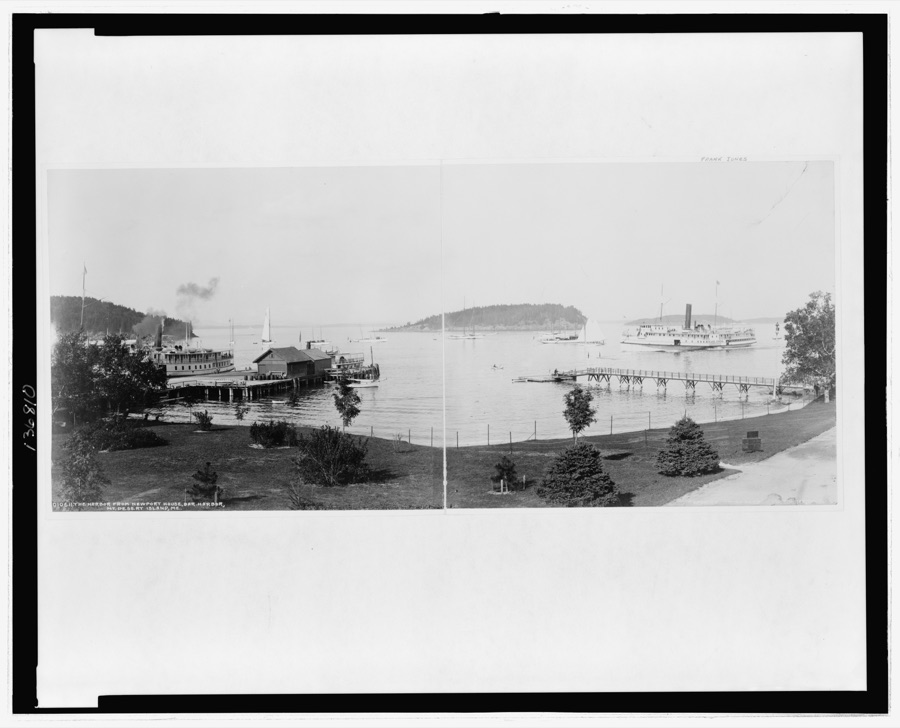
Roberts understood, before most of his neighbors, that the village's future would depend on transportation. Before 1857, steamboat service to Mount Desert Island had only one port of call — Southwest Harbor, on the far side of the island. That year Tobias built a simple wooden wharf at the foot of Main Street in Bar Harbor. The steamboat Rockland began making weekly stops. In 1867 the wharf was expanded, and the Lewiston began regular service. By 1881 the Mount Desert Herald could report that "now we have steamers City of Richmond, Lewiston, Mt. Desert, Little Buttercup, Acadia, and Queen City of Bangor all running to and from this port."
The wharf, the hotel, and the steamers fed one another. Each wave of visitors needed lodging; each new hotel needed more steamers; each new steamer brought another wave of visitors. By the late 1860s the Roberts wharf was the single most important piece of infrastructure on Mount Desert Island, and Tobias owned it.
The Children
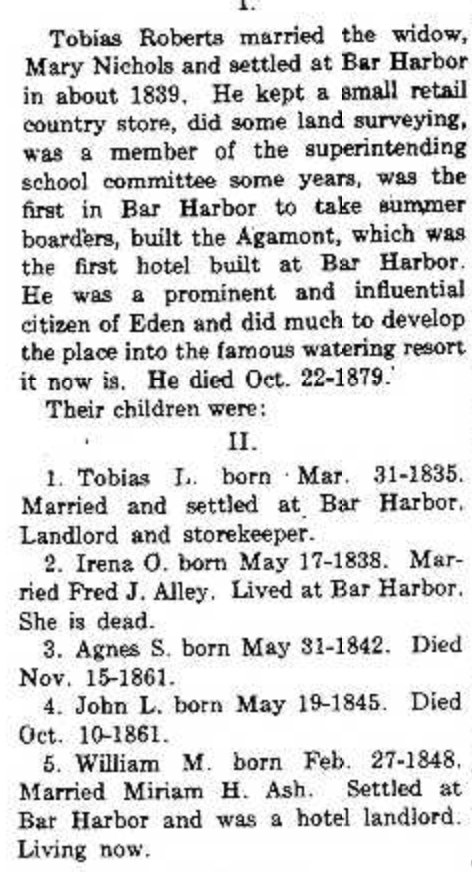
Tobias and Mary had at least seven children. Five survived to adulthood; two did not.
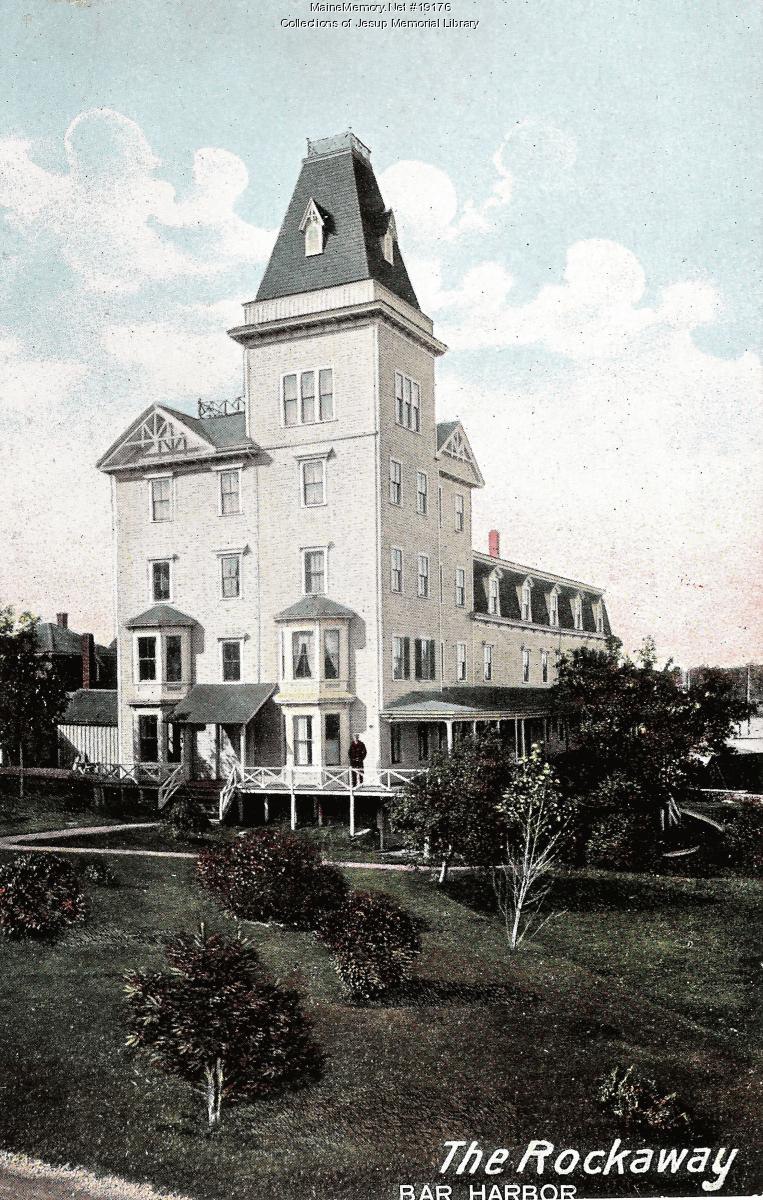
- Tobias L. Roberts (March 31, 1835 – February 1908) — landlord and storekeeper; built the Rockaway Hotel in 1870; died one of Bar Harbor's wealthiest permanent residents.
- Irene O. Roberts (May 17, 1838 – March 28, 1897) — married Frederick J. Alley in 1854; ran the St. Sauveur Hotel with her husband.
- Agnes (Aquea) S. Roberts (May 31, 1842 – November 15, 1861) — died at nineteen.
- John L. Roberts (May 19, 1845 – October 10, 1861) — died at sixteen, weeks before his sister Agnes.
- William M. Roberts (February 27, 1848 – February 12, 1929) — built the Newport House in 1868 at age twenty; ran it for forty-five years; the last surviving Roberts brother.
The deaths of Agnes and John within five weeks of each other in the autumn of 1861 — at sixteen and nineteen — would have devastated the family. The cause is not recorded; the simultaneity strongly suggests epidemic disease, very common in coastal Maine in the early 1860s.
A third generation carried the name. Tobias Lord Roberts III (January 8, 1888 – November 19, 1956), the grandson of Tobias Sr. and son of Tobias L. Jr., is buried in the family plot alongside his father and grandfather.
A Family of Hotels
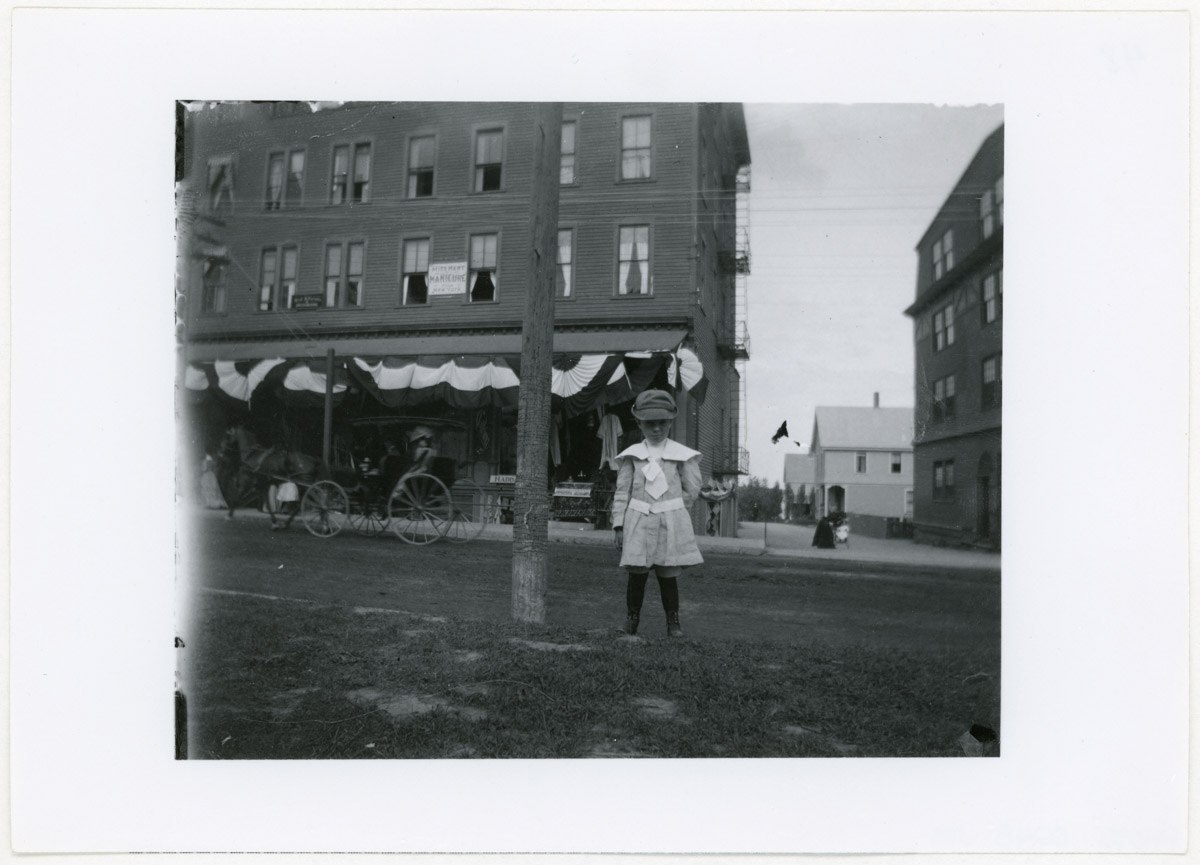
By 1870, three branches of the Roberts family were building or operating hotels within a few hundred yards of one another at the head of Main Street. Tobias ran the Agamont. His son Tobias L. built the Rockaway in 1870, a four-story Mansard-roofed building on the eastern side of what is now Agamont Park. His youngest son, William M. — twenty years old — had built the Newport House two years earlier, in 1868. And his daughter Irene and her husband, Frederick Alley, were finishing the St. Sauveur Hotel on Mount Desert Street with money borrowed from a Lamoine creditor against Irene's land.
By 1870, fourteen hotels stood in Bar Harbor. By 1880, eighteen. The town's postmaster built one and named it after himself. But the founding cluster — Agamont, Rockaway, Newport House, St. Sauveur — was a family compound.
The Will of 1878
Tobias Roberts wrote his will on August 24, 1878. He had been a hotel keeper for twenty-three years, a wharf-owner for twenty-one, an Eden resident for thirty-nine. He identified himself in the opening line as "of Eden in the County of Hancock in the State of Maine, now residing in that part of said Eden called 'Bar Harbor.'" — a small but deliberate use of the village name as it was becoming a place in its own right.
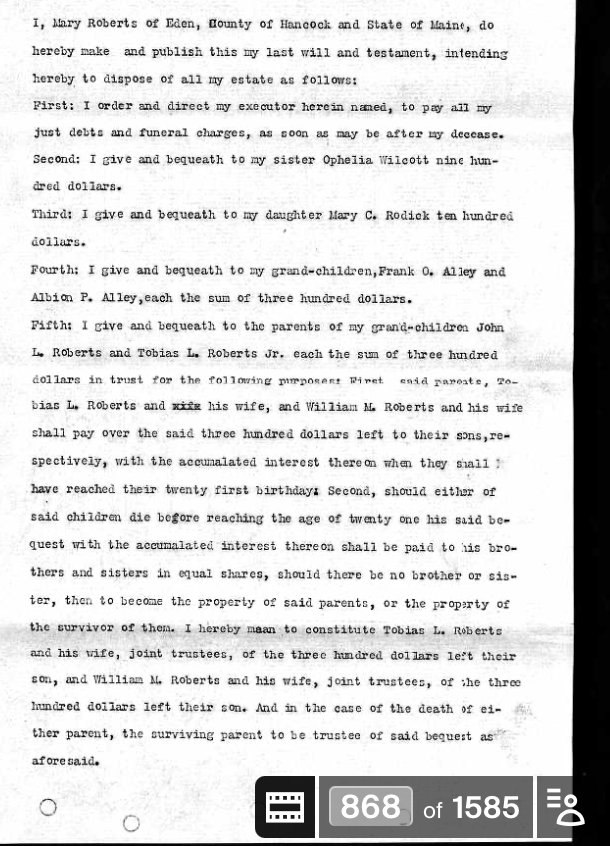
The will distributes a substantial estate. Tobias's wife Mary receives $4,000 plus the family home and the "Newport Cottage" — the cottage adjacent to William's Newport House — for her lifetime. Tobias L. receives $2,000 and Sheep Porcupine Island in Frenchman Bay. William M. receives $2,000, the Newport House with all its furniture, and the parcel of land beneath it. Each surviving grandchild receives $200 in trust until twenty-one. The Congregational Society at Bar Harbor receives $200 in trust to pay the minister's salary, plus $100 for the Foreign Mission Fund.
For his daughter Irene Alley, Tobias makes a careful and revealing bequest: $4,000 in cash plus an acre of land in Bar Harbor adjacent to property already owned by her husband — placed entirely in a separate trust for her sole use, beyond the reach of her husband Frederick or any future husband. The provision is unique in the will; nothing similar is attached to either of Tobias's sons' devises. It is one of the most direct surviving statements of how Tobias felt about his son-in-law, and it deserves to be read in the context of the Alley family's own page.
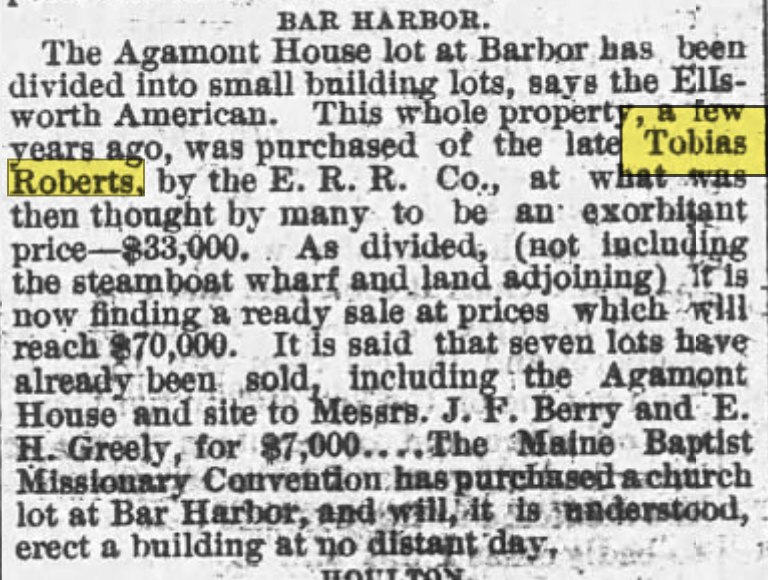
Tobias died in October 1879. The will was admitted to probate the following June. By the time of his death he had also sold the Agamont House and its adjoining land to the Eastern Railroad Company for $33,000 — a sum that contemporaries thought astonishing.
Politics
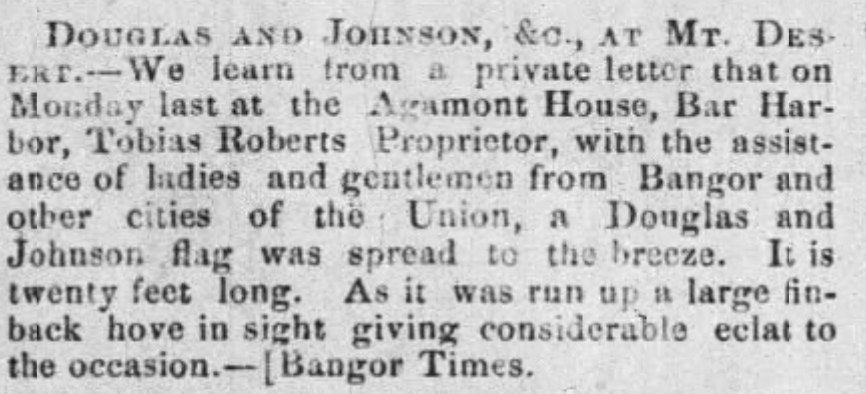
Tobias was a conservative Democrat. In the summer of 1860, on the eve of the election that would put Abraham Lincoln in the White House, Tobias raised a twenty-foot banner over the Agamont House — for Stephen A. Douglas and Herschel V. Johnson, the Northern Democratic ticket. A flock of women and gentlemen from Bangor and other Union cities assisted in the flag-raising. As the flag went up, a fin-back whale surfaced offshore, "giving considerable éclat to the occasion."
His son-in-law Frederick Alley would later carry the same political convictions to the same hotel — leading torch-lit parades for Grover Cleveland from the St. Sauveur in 1884.
The Old Agamont Burns
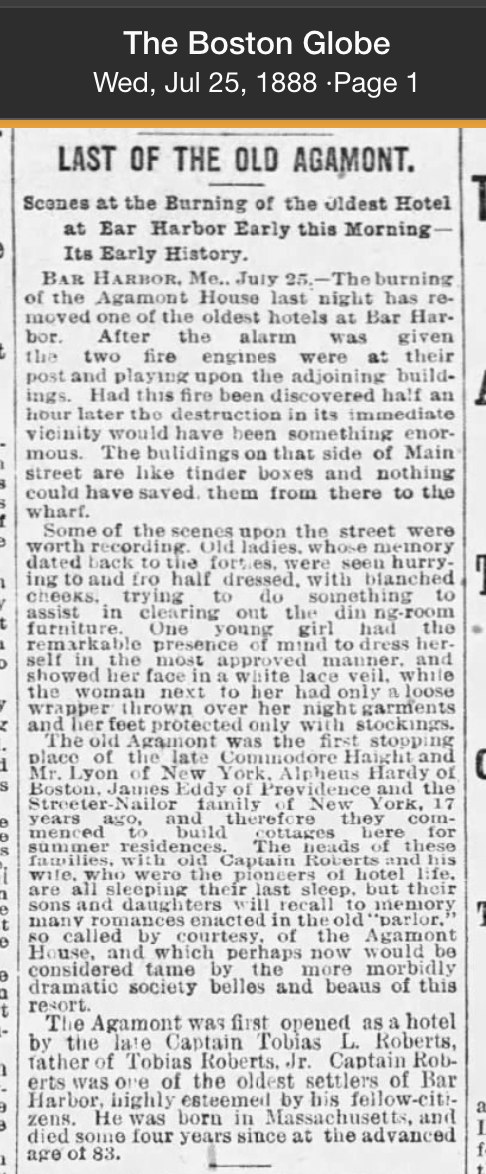
The original Agamont House — the "little barn-like structure" that Tobias had converted in 1855 — burned to the ground on the night of July 24, 1888, nearly nine years after Tobias's death. The Boston Globe sent a reporter, who described society guests fleeing in evening dress, "one young girl had the remarkable presence of mind to dress herself in the most approved manner, and showed her face in a white lace veil." The fire was reported as "removing one of the oldest hotels at Bar Harbor."
The Globe's account is also one of the more affectionate descriptions of Tobias to appear in print: "the old Agamont was the first stopping place of the late Commodore Haight and Mr. Lyon of New York, Alpheus Hardy of Boston, James Eddy of Providence, and the Streeter-Nailor family of New York, 17 years ago. The heads of these families, with old Captain Roberts and his wife, who were the pioneers of hotel life, are all sleeping their last sleep." The honorific "Captain," like the one Frederick Alley would later claim, appears here without further explanation; it was probably a courtesy title for a senior militia officer rather than a maritime one.
Tobias L. Roberts (1835–1908)
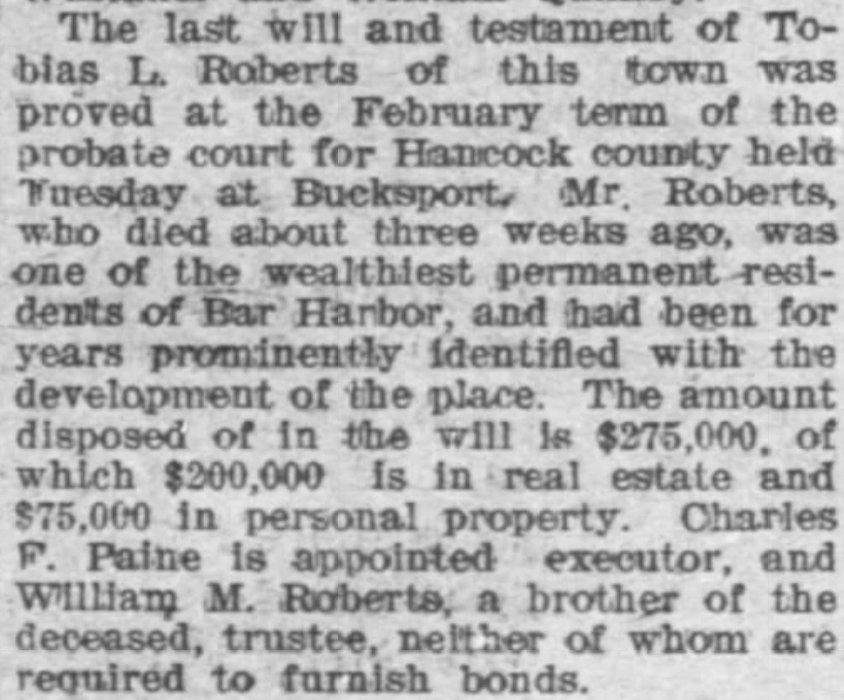
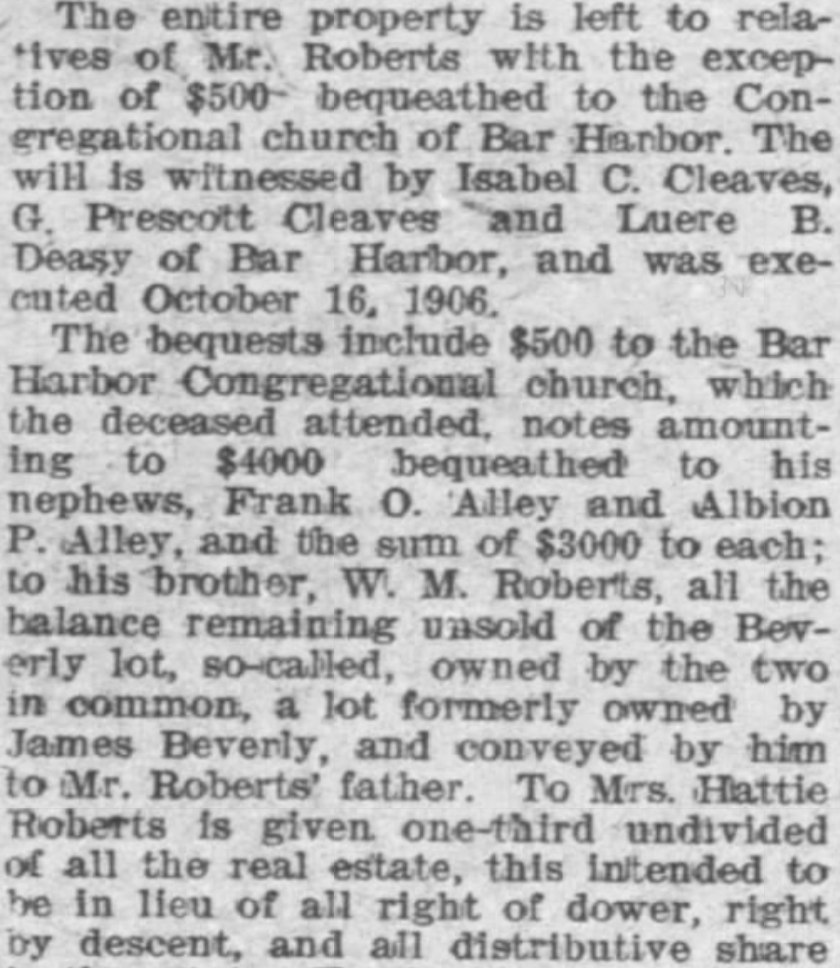
The eldest son inherited his father's gift for accumulating land and his eye for the rising market. When he died on January 16, 1908, the Bangor Daily News reported that his estate totaled $275,000 — $200,000 in real estate and $75,000 in personal property. In present-day dollars, the estate exceeded $9 million. The will, executed in October 1906, was witnessed by Isabel C. and G. Prescott Cleaves and Luere B. Deasy of Bar Harbor. Charles F. Paine was appointed executor; Tobias's younger brother William M. Roberts was named trustee.
Tobias L. left $500 to the Bar Harbor Congregational Church, $4,000 in promissory notes to his nephews Frank O. and Albion P. Alley (Irene's two surviving sons), $3,000 to each of them in cash, and one-third of his real estate to his widow Hattie. The remainder was to be invested and managed for the benefit of his two children, Tobias L. Roberts Jr. and Mary S. Roberts. The estate, in a generation, had grown from Tobias Sr.'s "fortune of $50,000" to nearly six times that figure.
William M. Roberts (1848–1929)
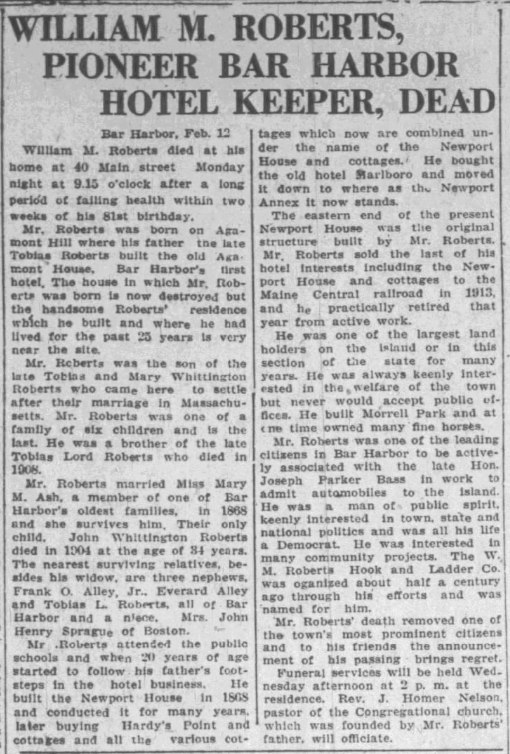
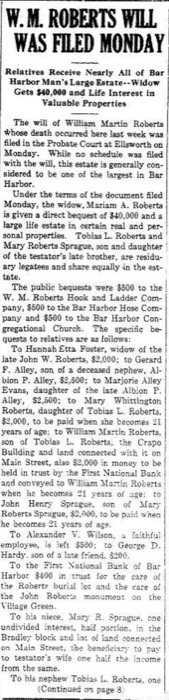
The youngest brother outlived them all. William M. Roberts was born February 27, 1848, on Agamont Hill, in the house his father had built. He left school at twenty to build the Newport House and ran it for forty-five years, adding wings and absorbing the neighboring cottages and the old Marlboro Hotel as Bar Harbor expanded. He served as a director and vice-president of the Bar Harbor National Bank. He helped found the W.M. Roberts Hook and Ladder Company. He was, his obituary said, "one of the leading citizens in Bar Harbor to be actively associated with the late Hon. Joseph Parker Bass in work to admit automobiles to the island." His only child, John Whittington Roberts, died in 1904 at the age of thirty-four.
William sold his hotel interests to the Maine Central Railroad in 1913 and "practically retired that year from active work." He died at his home at 40 Main Street on February 11, 1929, two weeks short of his eighty-first birthday — the last of the Roberts siblings.
From the Registry
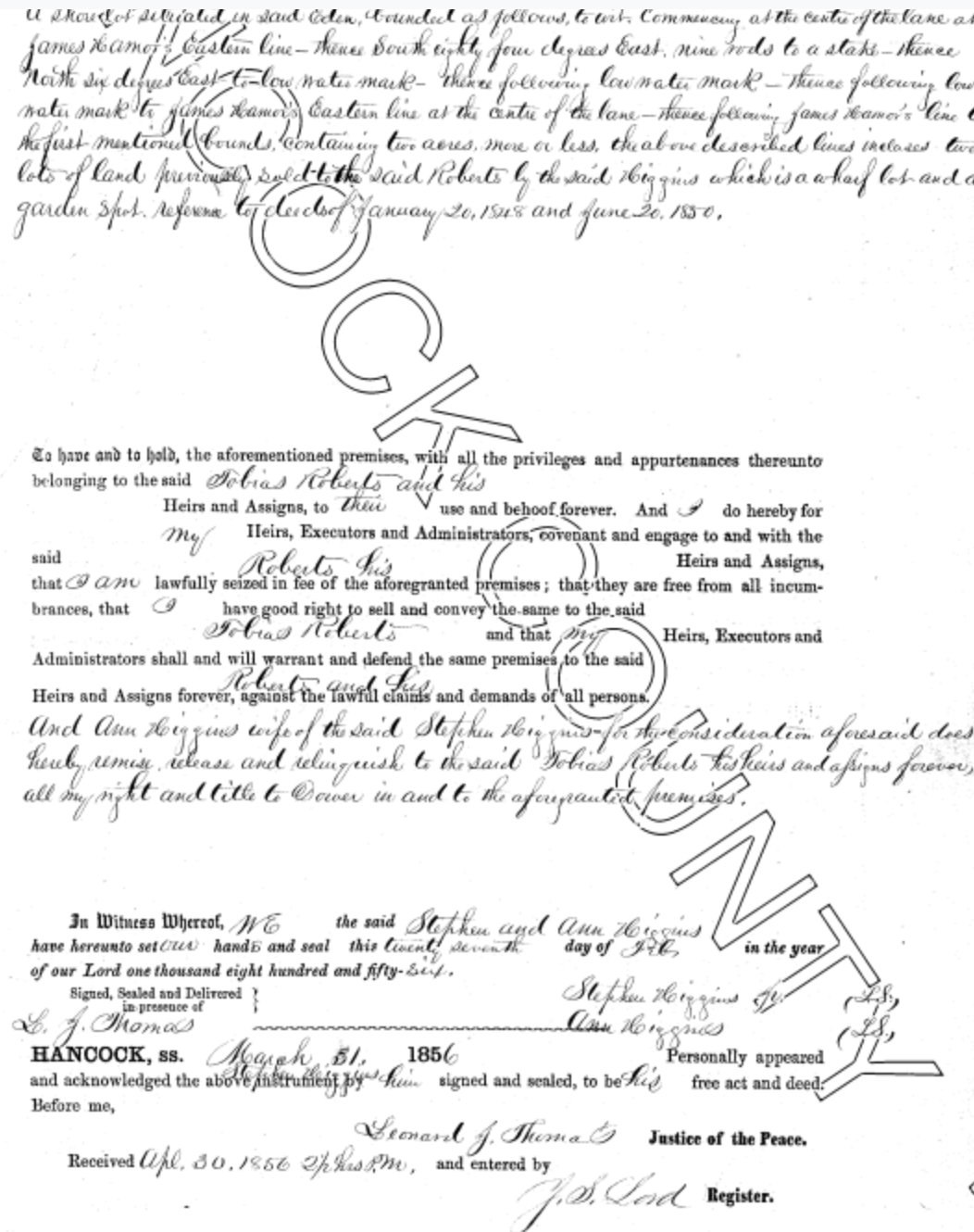
Two documents from the Hancock County Registry of Deeds capture the Roberts family's land accumulation in miniature.
The first is from 1856 — a deed by which Stephen Higgins, Jr., shipbuilder of Eden, consolidates two earlier conveyances of waterfront land into a single two-acre parcel for Tobias Roberts. The deed describes "a wharf lot and a garden spot." It is, in effect, the moment Tobias becomes a Bar Harbor waterfront owner.
The second is from 1873 — Tobias, by then prosperous, deeding a small lot near the Steam Boat Wharf to his son Tobias L. for the nominal sum of $50. The reference to "the Steam Boat Wharf" as a navigational landmark dates the document precisely: Bar Harbor by 1873 was no longer a fishing village but a tourist destination, with infrastructure named after its primary commercial function.