Beginnings
Juliette was born in April 1843, in the first house ever built in what would become Bar Harbor — a house raised by her maternal grandfather, Captain Zacheus Higgins, on what is now Eden Street. The Higginses were among the earliest European families on Mount Desert Island. Her mother, Betsy Higgins Nickerson, was one of his daughters; her father, Sparrow Nickerson, was a Wellfleet sailor who had married into the island and was, in his time, "one of the best mariners of his day and owner and skipper of one of the finest of that packet fleet which sailed up the New England coast."1
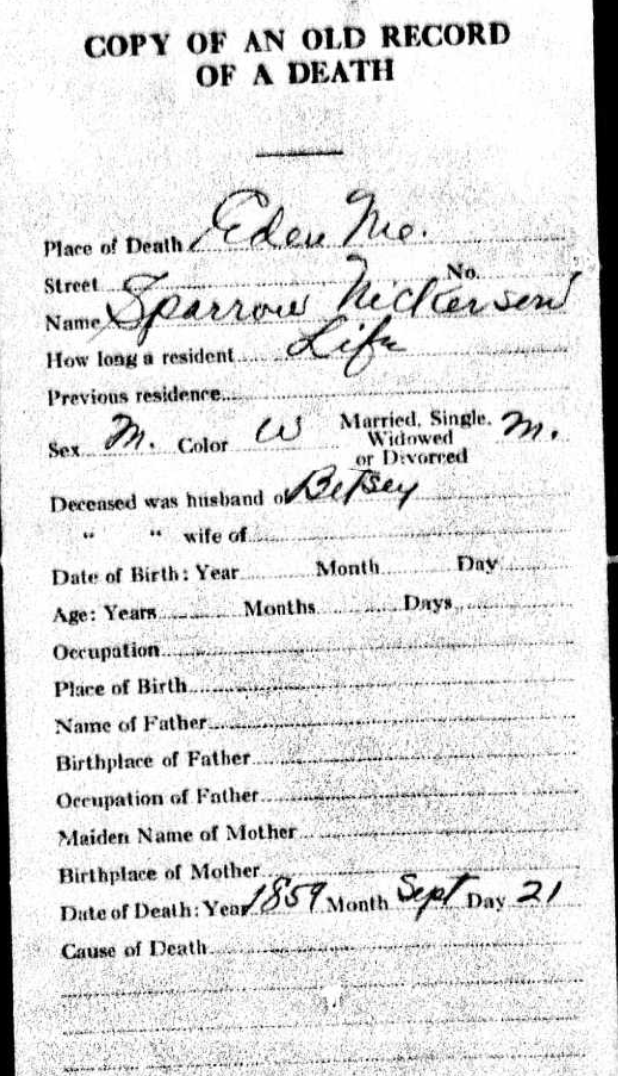
It was a large family, and a doomed one. Sparrow died of consumption in September 1859, age forty-four, when Juliette was sixteen. Of her five siblings, four died young: Louisa at sixteen, Henry at twenty-six, Ann at thirty-one, Albertina at twenty-five. Only Juliette and her brother John survived past thirty. The 1860 census finds the household still grieving — Betsy, forty-eight, widowed, with Juliette and the surviving children gathered around her. They lived on the Higgins land alongside Juliette's great-uncle Zacheus, the captain "very old, but splitting firewood," and his invalid wife.
A child without a name
Sometime around 1868, when Juliette was about twenty-five, she had a son. She named him Edwin Forrest Nickerson. The space for his father's name on the records was left blank — and would remain blank for the rest of his life. Whatever Juliette's reason, she had little interest in passing on the father's name; when Edwin died of tuberculosis in Caribou, Maine, at the age of thirty-two, having travelled north hoping the change of air might save him, the line for the father on his death certificate was left empty as well. By all available evidence, Juliette raised him alone.
In 1880, the census-taker found her at home, age thirty-seven, "keeping house" with her sisters Albertina and Ann and her twelve-year-old son. Within two years both sisters would be dead. Edwin would not live to see thirty-five.
A pioneer in woman's dress
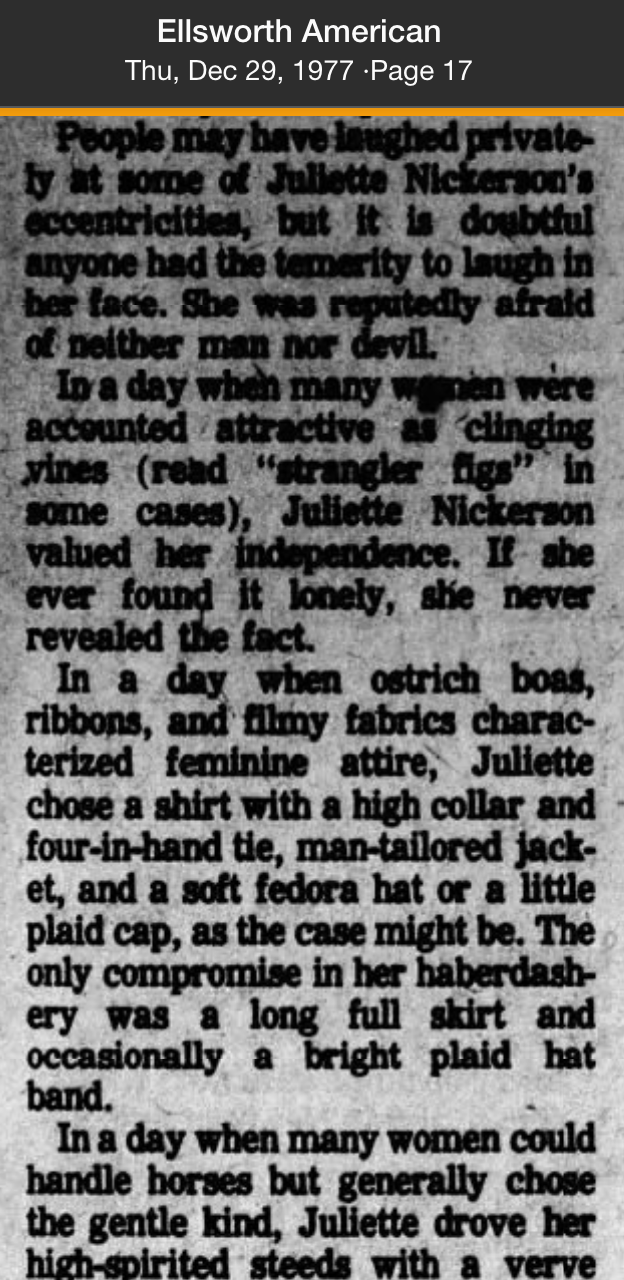
In a town and a decade in which "ostrich boas, ribbons, and filmy fabrics characterized feminine attire," Juliette wore a shirt with a high collar and a four-in-hand tie, a man-tailored jacket, and a soft fedora or a little plaid cap. Her hair, all her life, was cut short "like the average man." Her only concession to the century's expectations was a long full skirt — and, on occasion, a bright plaid hatband.2
Her obituary called her, plainly, "a pioneer in woman's dress" — noting that "only in recent years has her example been followed to any extent by other members of her sex."1 Bar Harbor in 1900 was not, on the whole, an experimental place; what permitted Juliette's defiance was probably some combination of her family's standing on the island, her independence after her son's death, and a personality, in the words of one paper, of "grit" and refusal to be intimidated. Story had it that, "when she was very young and indiscreet, she once dressed in boy's clothes, ran away, and went to work as a hostler."2
Three horses, and no patience for cruelty
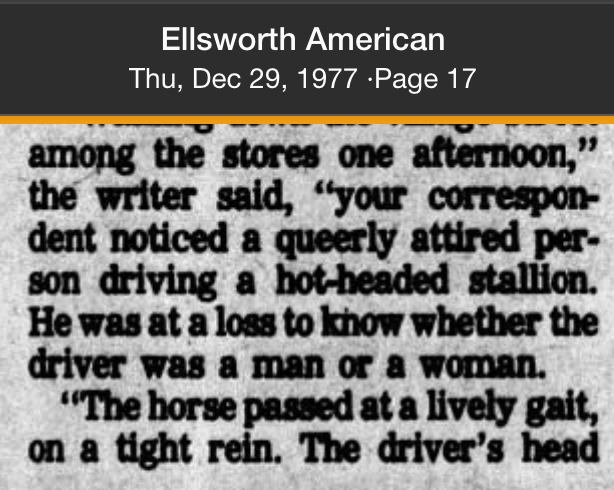
She loved horses — owned, at various times, three of them, and ran a livery and boarding stable in the early days of Bar Harbor. She drove fast and well. A visiting newspaper correspondent, late in the 1890s, watched her drive a stallion through the village and was unable to tell at first whether the driver was a man or a woman:
It was a woman, the most famous woman in town, Miss Juliette Nickerson. Her face is pleasant and not masculine, her hands are small, but her attire is as near a man's as she can make it and wear skirts. She owns three horses and there is not a poor piece of flesh in the lot. She spends most of her time in exercising her horses, and seems to enjoy life more keenly than any woman on the Island.
quoted in the Ellsworth American, 1977
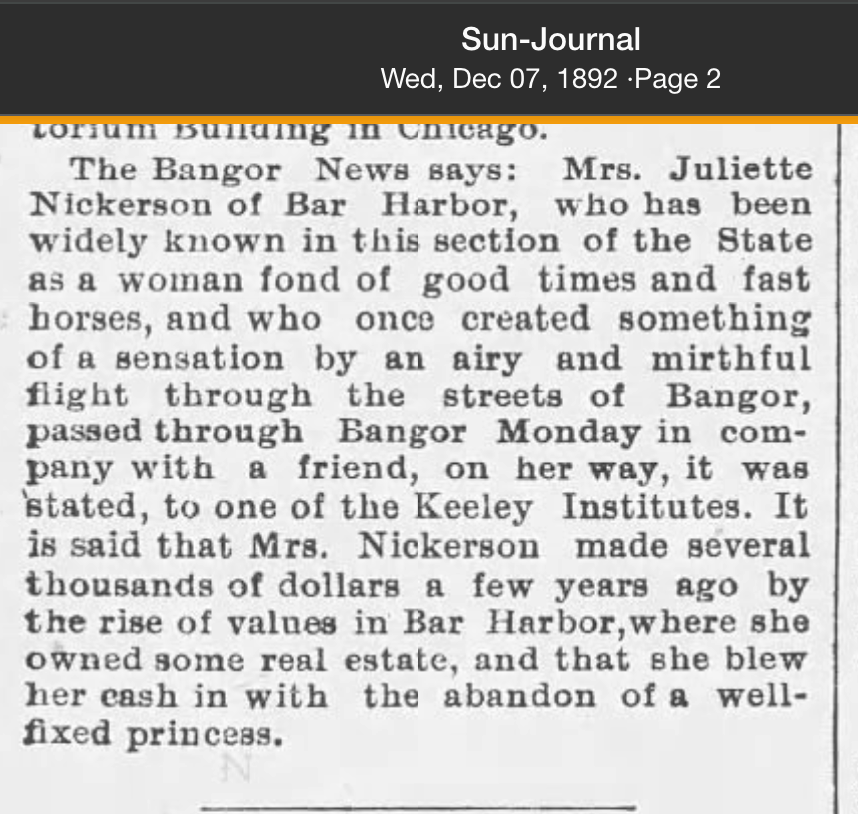
She owned a Hamilton-Knox stallion named Centennial, "famous for both speed and beauty," and a black horse "that could show you a clip in 27." In 1892 the Bangor papers reported she had made several thousand dollars in the early speculation of Bar Harbor real estate "and blew her cash in with the abandon of a well-fixed princess."3
Whatever her own private struggles, her public commitment to the welfare of animals was absolute. She once drove out to Orland to shoot a horse she had judged to be mistreated, and was sued for her trouble. The court found her guilty only of trespassing and fined her seven dollars.
An honorary person
After her son's death, Juliette found her work. She became a local leader of the Woman's Christian Temperance Union — vice president of the Hancock County chapter by 1897 — and organized annual conferences in Bar Harbor and Stonington, where she gave anti-narcotic addresses. The WCTU, in those years under Frances Willard's leadership, was not yet the single-issue prohibition movement it would become; it campaigned for women's suffrage, labor laws, and prison reform alongside temperance. When the WCTU's feminism waned after Willard's death, Juliette redirected her energy toward animals and children.
For more than thirty years she served as the Hancock County agent for the Maine Society for the Prevention of Cruelty to Animals, and for sixteen years as agent for the Society for the Prevention of Cruelty to Children — both by appointment of the governor. She investigated cases of abuse and neglect across the state, landing on outer islands like Beech and Mouse where, men told her, no woman could go ashore — and where it was "hard even for men" to get to. Her contemporaries marvelled at her grit. They also marvelled at her incorruptibility:
She was an honorary person in this job — not to be bribed through the influence of vote-getting, as so many men officials are. She admonished the roughest working man and the bluest blood.
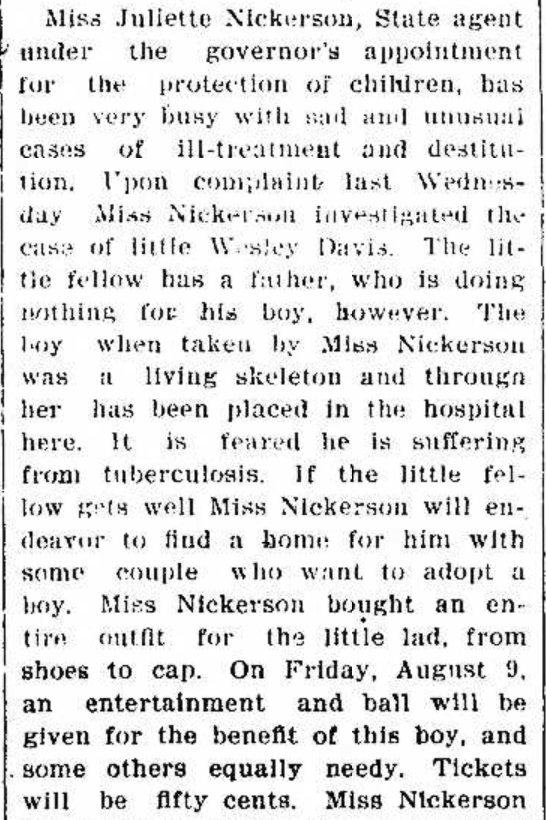
She was eventually appointed a deputy sheriff — reportedly the oldest woman to hold the office in the United States.1
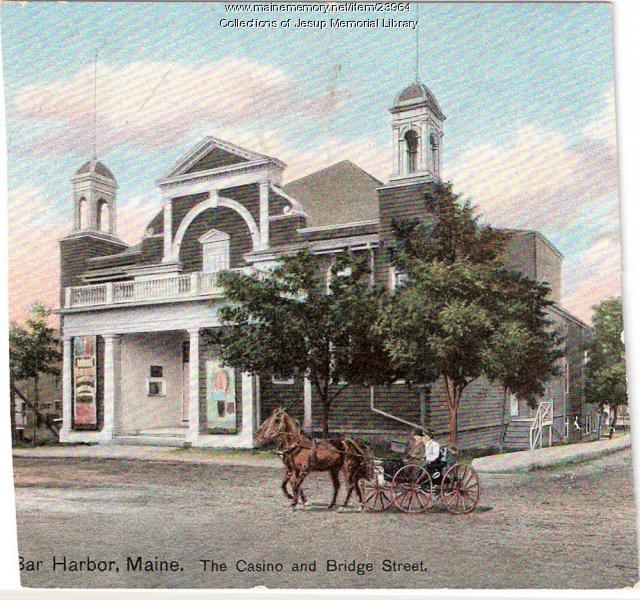
To fundraise for the SPCA, she held an annual summer dance at the Casino, the great hall on the corner of Bridge and Cottage Streets where Bar Harbor held its plays and graduations and town meetings.
92 Main Street
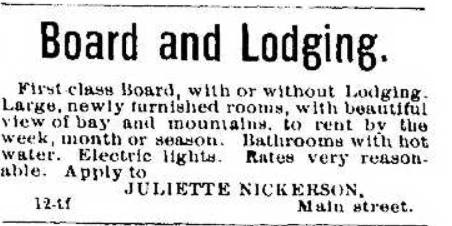
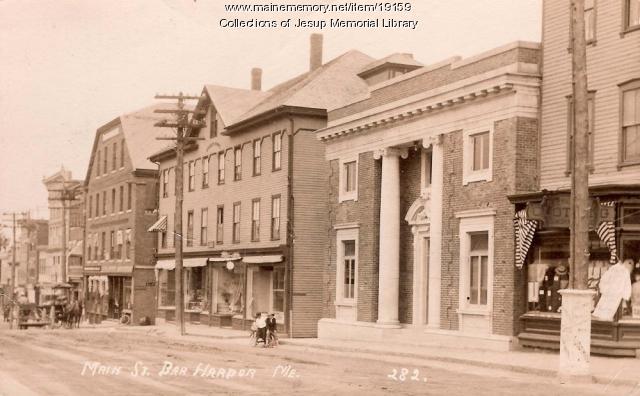
From at least 1898, when she advertised "first class Board, with or without Lodging, large newly furnished rooms, with beautiful view of bay and mountains," Juliette ran a boarding house on Main Street.4 Later in life she kept rooms there herself, at 92 Main — a tall columned building now part of the First National Bank.
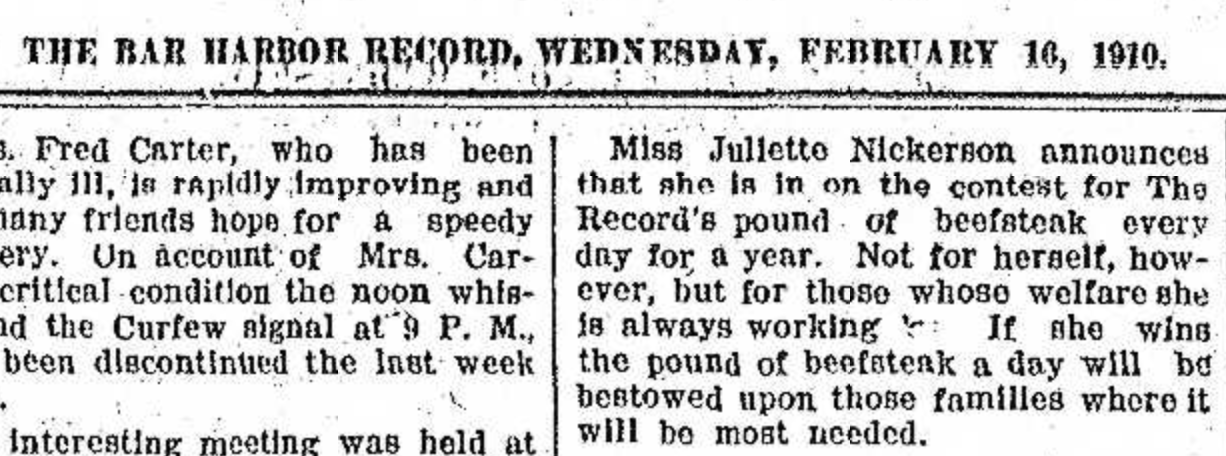
Her building drew an eclectic set of tenants. In 1910 the Bar Harbor Record ran her notice that she had entered the paper's "pound of beefsteak every day for a year" contest — "not for herself, however, but for those whose welfare she is always working." The same page carried a help-wanted ad from her landlady, Mrs. E. H. Higgins, for "a plain cook for boarding house not over 20 people."
Over the years 92 Main Street was variously home to Madame Zola the palmist ("Most reliable woman in her profession. A reader for 25 years"), an eyesight specialist named M. Ray Clark, a French dressmaker called Fleure Giano, and a typewriter agent named L. W. Templeton selling the Corona Four "with the standard single-shift keyboard." Juliette lived in the middle of it.
Last years
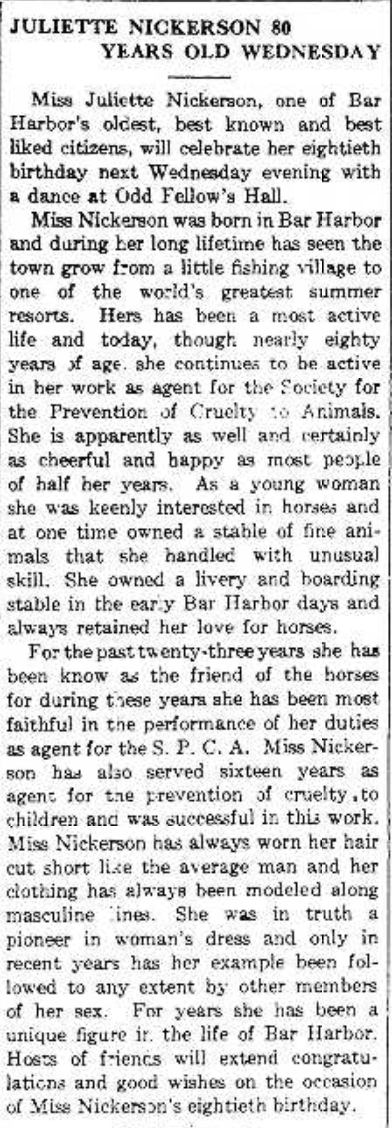
On her eightieth birthday, in April of 1923, the paper congratulated her with the kind of long, admiring notice usually reserved for outgoing officials. "Hers has been a most active life," it said, "and today, though nearly eighty years of age, she continues to be active in her work as agent for the Society for the Prevention of Cruelty to Animals. She is apparently as well and certainly as cheerful and happy as most people of half her years."5
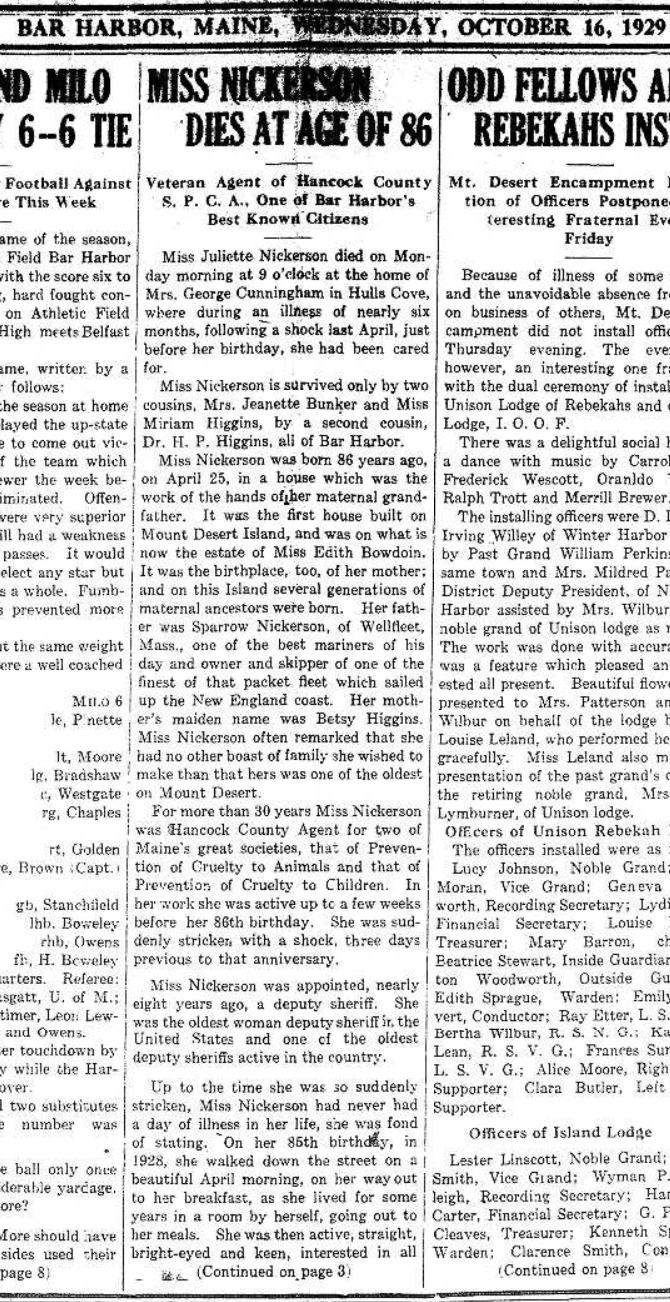
She kept working. She kept walking down Main Street to her breakfast. In the spring of 1929 she suffered a shock; she was cared for through the summer at her cousin Mrs. George Cunningham's house in Hulls Cove. She died there on the morning of 14 October 1929, three days after another shock; she was eighty-six. The obituary ran in the Bar Harbor Times two days later, on the same front page as a tie in the local football game and the installation of new officers at the Odd Fellows Hall.
She is buried here, in the Mount Desert Street Cemetery, near the parents and siblings who went before her — Sparrow and Betsey, Louisa and Albertina, Ann and Henry, all of whom she outlived by decades. Her son Edwin lies elsewhere. The grave does not have much to say. The newspapers said the rest.
Nickerson stones at this cemetery
- Capt. Sparrow Nickerson 1815 – 21 September 1859 Juliette's father
- Betsey Higgins Nickerson 18 January 1812 – 24 May 1869 Juliette's mother
- Louisa Nickerson 13 October 1845 – 16 July 1862 sister, died at 16
- Henry W. Nickerson 25 August 1851 – 27 November 1877 brother, died at 26
- Albertina Nickerson 28 September 1854 – 15 June 1880 sister, died at 25
- Ann Maria Nickerson 14 April 1850 – 6 December 1881 sister, died at 31
- Juliette Nickerson April 1843 – 14 October 1929