Some seventy people named Higgins are buried in the Mount Desert Street Cemetery — by a long margin, the largest concentration of any single family in this ground. They include the first European settlers of Bar Harbor; sea captains who took schooners and full-rigged ships to Labrador, Portugal, the West Indies, and the open Atlantic; farmers who cleared the original 200 acres at Eddy's Brook and the adjoining lots along what is now Mount Desert Street; mill owners; carpenters; town selectmen of Eden; and a commander in the United States Coast Survey. Half a dozen of them died at sea. Most did not.
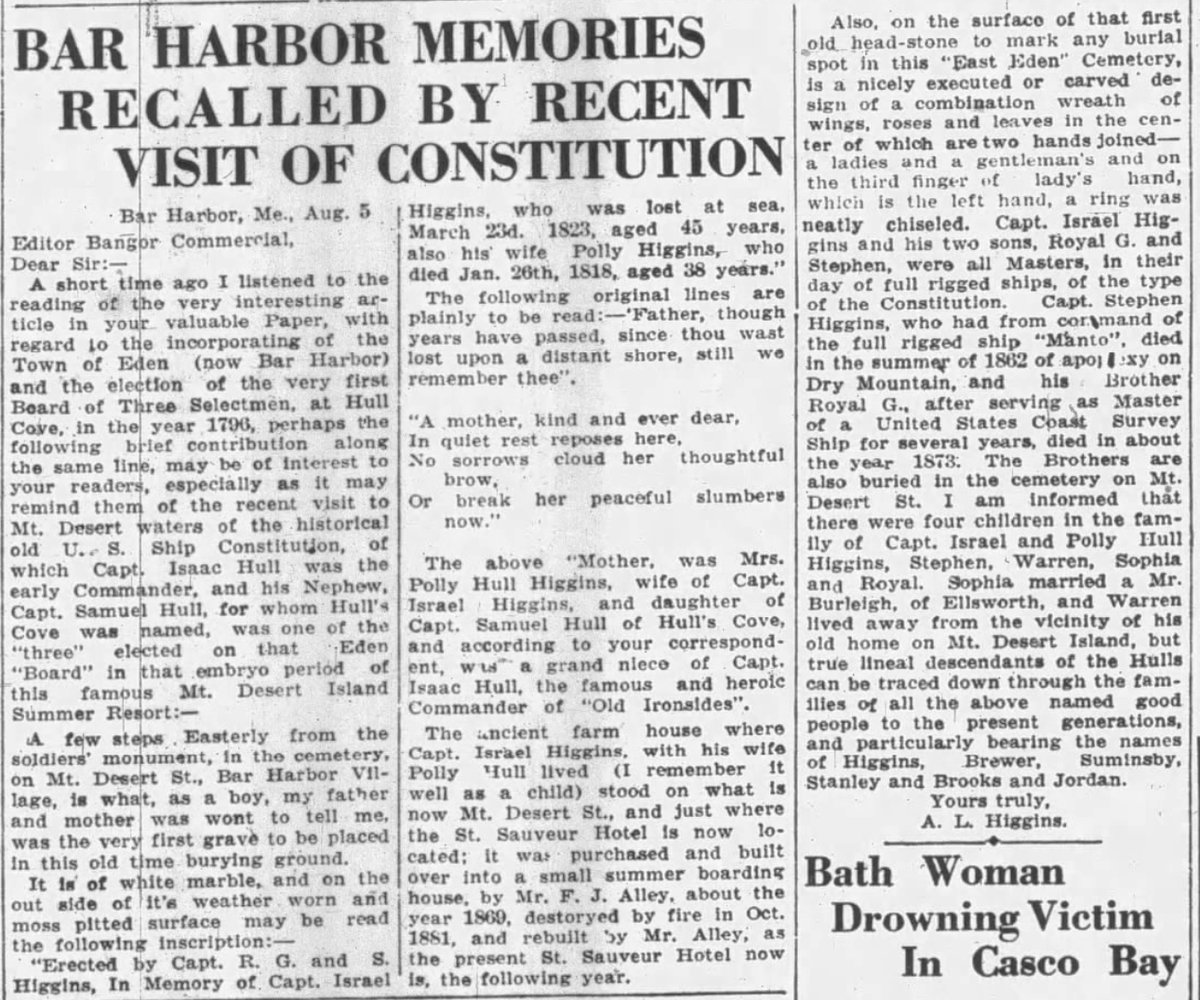
Capt. Israel Higgins was lost at sea on March 23, 1823, when the schooner Julia Ann, of Lubec, went down twenty-five miles south of Sandy Hook, N.J. His twelve-year-old son Seth was on board with him. His wife, Polly Hull Higgins, had been buried five years earlier, on Feb. 26, 1818. The weathered marble headstone in the cemetery — topped with a winged hourglass and a pair of clasped hands — bears both their names. A letter from his grandson to the Bangor Commercial in 1931, on the occasion of the USS Constitution's visit to Mount Desert waters, called hers "the very first grave to be placed in this old time burying ground."
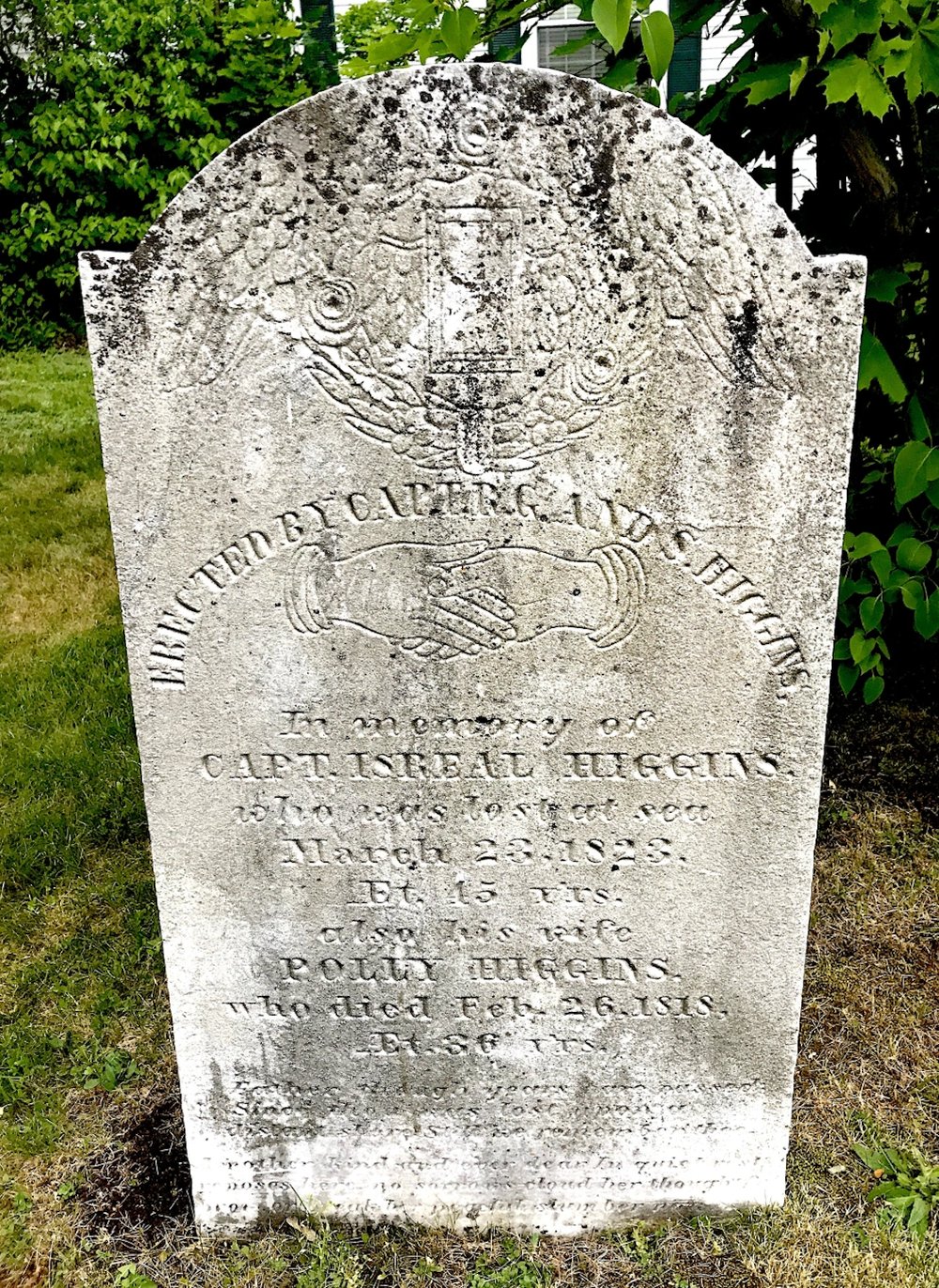
The man named on the stone was born in Bar Harbor on March 5, 1778 — probably the first child of European descent born in the place that would become this town. His father, Israel Higgins Sr., had arrived from Cape Cod in 1771 with his wife Mary Snow and built the family farm at Eddy's Brook, on land for which no European had yet drawn up a clear title.
The Family
Five generations of the founding Higgins line — from the Cape Cod founders through their five Bar Harbor sons and their wives, the nine children of Capt. Israel and Polly, and on through Capt. Royal Grant's descendants. Click any person to read their story.
The first settler
Israel Higgins Sr. was born about 1742 in Eastham, on Cape Cod, the son of Zaccheus Higgins and Rebecca Young. The family traced its line to Richard Higgins, an original settler of Plymouth Colony in the 1630s.
He married Mary Snow at Eastham in November 1767. Three years later, in 1771, the couple sailed north and made landfall at Mount Desert Island. The town of Eden — what is now Bar Harbor — did not yet exist. According to George E. Street's History of Mount Desert, Israel "went from Cape Cod with his wife Mary Snow and settled on the shore near Eddy's Brook. They took up some two hundred acres of land ever since known as the Israel Higgins lot." Street called him "one of the first, perhaps the first, settler of Bar Harbor."
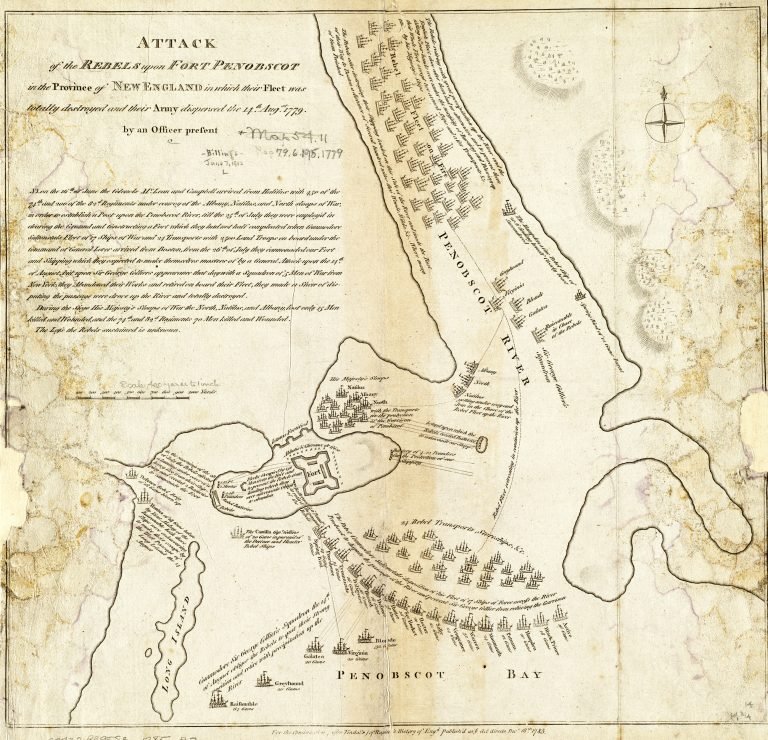
He served the early settlement as constable and deer-reeve. In July 1779 he volunteered for the Penobscot Expedition, the American attempt to dislodge British forces from what is now Castine. Eden's payroll records show him serving from July 28 to Sept. 28, 1779, in the company of Capt. Daniel Sullivan. The expedition collapsed when a British fleet arrived; some 700 Americans, six small cannon and 10 ships were "totally destroyed," and the survivors escaped overland. Israel made it home.
He and Mary Snow had at least seven children. Two boys died young at Eastham. Of those who lived, five sons established themselves along the Bar Harbor shore: Henry, Stephen, Oliver, Israel Jr., and Zaccheus.
How settlers got their land
The shore on which Israel Higgins built his farm had been Wabanaki territory for thousands of years before he arrived. The Penobscot, Passamaquoddy, and other peoples of the Wabanaki Confederacy — "the People of the Dawnland" — had fished, gathered shellfish, and maintained seasonal settlements along the coast of what is now Maine for longer than any European map had recorded it. By the time the Higginses sailed up from Cape Cod, however, two and a half centuries of contact with Europeans had transformed the region. Successive epidemics of smallpox, measles, and influenza had killed an estimated three-quarters or more of the Indigenous population of coastal Maine. Repeated wars between the English and French, with their respective Native allies, had displaced most of the survivors inland or northward. To Israel Higgins, sailing up from Cape Cod, the island appeared to be empty. It was not.
Nor was it, in any clear legal sense, his to take. The competing European paper claims on Mount Desert Island ran four-deep. The French king Louis XIV had granted the island in 1688 to Antoine de la Mothe Cadillac. Cadillac did little with it. After Britain took Maine from France in the Seven Years' War, the Massachusetts royal governor, Francis Bernard, received the island as a personal grant in 1762; he too did little with it, and lost the claim entirely when he sided with the Crown during the Revolution. The Wabanaki, meanwhile, continued to assert that the land was theirs.
The matter was complicated further in 1786, when Cadillac's granddaughter, Maria Therese de la Motte Cadillac, and her husband, Bartholomy de Gregoire, came over from France to Boston with the help of Thomas Jefferson and the Marquis de Lafayette, intending to revive the original royal grant. The Massachusetts General Court, sympathetic to French claims after the Revolution, issued a Resolve on June 29, 1787, that split the difference. The de Gregoires were assigned clear title to roughly 60,000 acres of unimproved land — about 60 percent of the original Cadillac grant. The improved portions — the cleared fields, the homesteads, the wharves — were assigned to the settlers who had built them.
On March 28, 1792, Bartholomy and Maria Therese de Gregoire made their way around Mount Desert Island and executed quitclaim deeds for each established household. Israel Higgins received title to 200 acres "in conformity to the Resolve of the General Court... passed the 29th day of June 1787." The deed describes the bounds: from "a stump the bounds between Solomon Higgins and Israel Higgins" — Solomon being a relative who had settled nearby and who would later wander away from home in a snowstorm and fall to his death from a cliff near Cromwell's Harbor — running 437 rods south, then 77 rods east, then north to the shore. The same day, the de Gregoires deeded 100 adjacent acres to Henry Higgins, Israel's eldest son, then twenty-two. The deeds were witnessed by Ebenezer Leland and Philip Langley, acknowledged before Paul Dudley Sargent, J.P., at Mount Desert on April 4, 1792, and recorded at the Hancock County Registry of Deeds on Sept. 1, 1794.
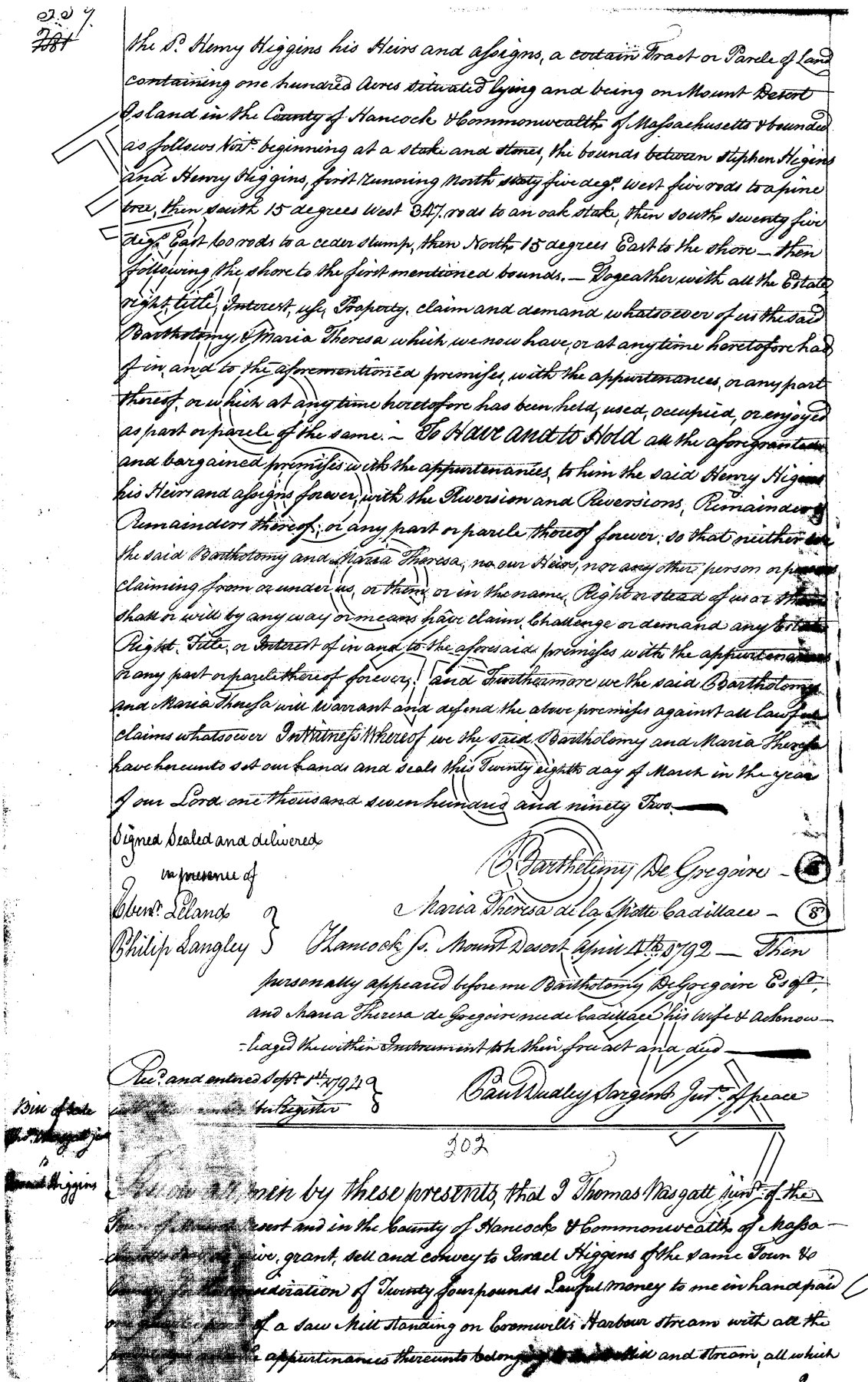
The price named in the deed is "five Spanish-milled Dollars." The real consideration, in the language the new state recognized, was Israel's standing as "a settler on the Lands herein limited to him." He paid neither the French Crown, nor the Massachusetts royal governor, nor the de Gregoires for the property. He did not pay the Wabanaki. The price, in the terms a young Massachusetts government recognized, had been twenty years of clearing trees.
Captain Israel
The fourth surviving son, and the first child born on the island, was Israel Higgins Jr., born March 5, 1778. He grew up a sailor. On Jan. 26, 1800, at twenty-one, he married Mary "Polly" Hull, eighteen, the daughter of Capt. Samuel Hull. Polly's father had settled at the cove on the south side of Mount Desert that came to be named for him by 1789; he kept a store there, built a number of vessels, and held the first town meeting at his own house, where he was chosen Eden's first selectman. His brother was Isaac Hull, who would later command the frigate USS Constitution against the British in the War of 1812.
By the time his son married, Israel Sr.'s business life had grown beyond the original Eddy's Brook farm. On Oct. 14, 1790, he had purchased a sawmill on Cromwell's Harbor Stream from Thomas Wasgatt Jr. for 24 pounds; the deed was witnessed by William Wasgatt and Solomon Higgins. Four years later, on Sept. 2, 1794 — two months after the de Gregoire deeds had been recorded at Castine — Israel, Henry, and Stephen Higgins jointly executed a mortgage bond to Samuel Jackson, a merchant of Plymouth, Mass., for £285, securing it with three separate mortgage deeds covering tracts of Mount Desert land. The brothers were operating as a financial unit, leveraging their newly-titled property for working capital. Israel retired the debt in June of 1800.
Israel Jr. himself served as a selectman of Eden in 1802, 1803, and 1809. On May 12, 1809, he took command of the schooner Hazard, a 120-ton, 63-foot vessel built that year for Samuel Hadlock of Little Cranberry Island. The Hazard was the first ship ever built in the town of Eden. She had been paid for, the records say, with the proceeds of Hadlock's haul of fish carried from Labrador to Oporto, Portugal, and home again with a cargo of citrus, onions, and salt.
Israel and Polly had nine children between 1800 and 1814: Jonathan, Samuel, Eliza, Stephen, Charlotte, Royal Grant, Seth, Sophia, and Warren. The farmhouse where they lived stood, A. L. Higgins's 1931 letter recorded, "on what is now Mt. Desert St., and just where the St. Sauveur Hotel is now located." The house was bought and converted into a small summer boarding house by F. J. Alley around 1869, destroyed by fire in October 1881, and rebuilt as the St. Sauveur Hotel the following year.
The year of three deaths
In 1818, the family lost three of its members within nine months. On Feb. 26, Polly Hull Higgins died at the age of thirty-six. She was the first person buried in the new village burying ground — the cemetery that is now called Mount Desert Street — and the white marble stone with the winged hourglass was set down over her.
On Nov. 2 of the same year, Mary Snow Higgins, Israel Sr.'s wife and the woman who had come from Cape Cod with him in 1771, died. Nine days later, on Nov. 11, Israel Sr. himself died at Bar Island.
Capt. Israel Jr. remarried the following summer, on Aug. 31, 1819 — Mrs. Zena Stanwood, a widow. She died less than two years later, on Sept. 18, 1821. He was twice widowed at forty-three.
The Julia Ann
On March 23, 1823 — by the date carved on his stone — Capt. Israel Higgins was lost at sea twenty-five miles south of Sandy Hook, N.J., on board the schooner Julia Ann, of Lubec. He was forty-five. With him was his son Seth, twelve.
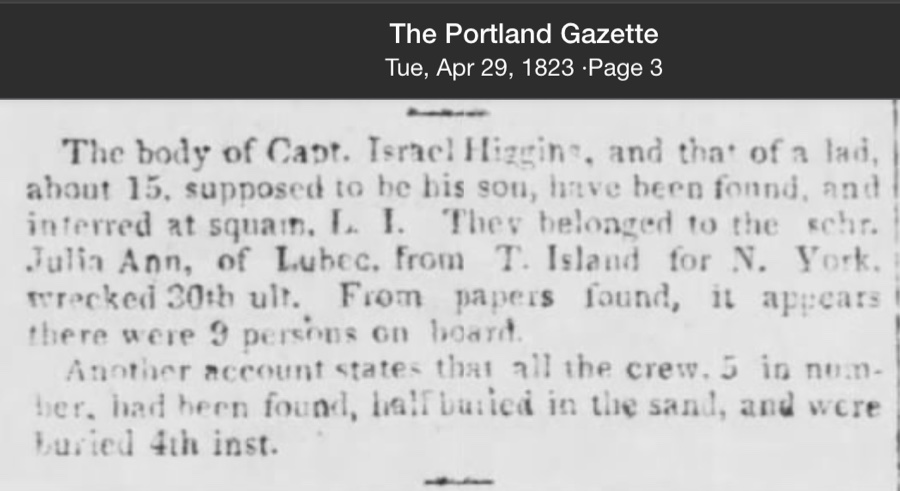
Their bodies were recovered and interred at Squam, on Long Island, with the rest of the ship's company. The stone at Mount Desert Street is a memorial only; the bodies were never brought home.
Of Israel and Polly's nine children, Jonathan, the eldest, was also lost at sea — in June 1824, on board the brig William, on a voyage from Havana to Portland. He was twenty-four. Samuel, the second son, had died at fifteen in 1816. Seth had gone down with his father at twelve. Four of the nine children were dead by the end of 1824. Three more — Stephen, Royal Grant, and Sophia — would live well into adulthood. Charlotte's and Warren's lives after Bar Harbor are not recorded in the sources at hand.
The brothers along Mount Desert Street
Capt. Israel's elder and younger brothers — Stephen, Oliver, and Zaccheus — all stayed in Bar Harbor. The eldest brother, Henry, born 1769, married Anna Coggins; another Henry Higgins, almost certainly of a younger generation, is buried in the plot with his wife Huldah Leland.
Stephen Higgins (1771–1852) married Deborah Wasgatt, born the same year. They lived to be eighty-one and seventy-four respectively and are buried together at Mount Desert Street.
Oliver Higgins (1776–1862) married Rhoda Leland (1782–1871). Their farm, according to A. L. Higgins's 1935 recollection of the old Mt. Desert Street houses, stood "a few rods" from his brother Capt. Israel's farmhouse — "the comfortable farm home and a very old weather beaten barn, and the dwelling of aged Mr. and Mrs. Oliver Higgins." They were cared for in old age by their sons William and Ezra and their daughter "Sally"; the property became, in time, the Ashurst Cottage. Four of their children lie in the plot with them: Sally (c. 1805–1876); Zacheus the Younger (1807–1856), who took his uncle's name; Ezra L. (c. 1815–1855); and Oliver J., who died at twenty-eight in November of 1853. The Sally and Ezra of the cemetery rolls are, by their dates, almost certainly two of the three siblings named in the 1935 recollection; William's stone, if he had one, is not recorded.
Capt. Zaccheus Higgins (1782–1867) — the youngest brother, born the same year as his sister-in-law Polly — married Rhoda's sister, Sarah Leland (1786–1869). He lived to be eighty-four. He owned the schooner Augusta Jane and ran wood from Kebo Mountain to Rockland. He and Sarah had at least nine children. One of their daughters, Betsey Higgins (1812–1869), married Sparrow Nickerson and is buried elsewhere in this cemetery with her own daughter Juliette. Another daughter, Ann Maria Higgins (1813–1883), married another Higgins — a carpenter named Stephen Higgins Jr. (c. 1813–1891) — and is buried with him in the plot. The marriage is documented by a deed in the Hancock County registry: on Jan. 14, 1848, the couple conveyed a 24-square-rod lot at Bay Harbor to Tobias Roberts for $45, with Ann Maria signing the deed to release her dower rights.
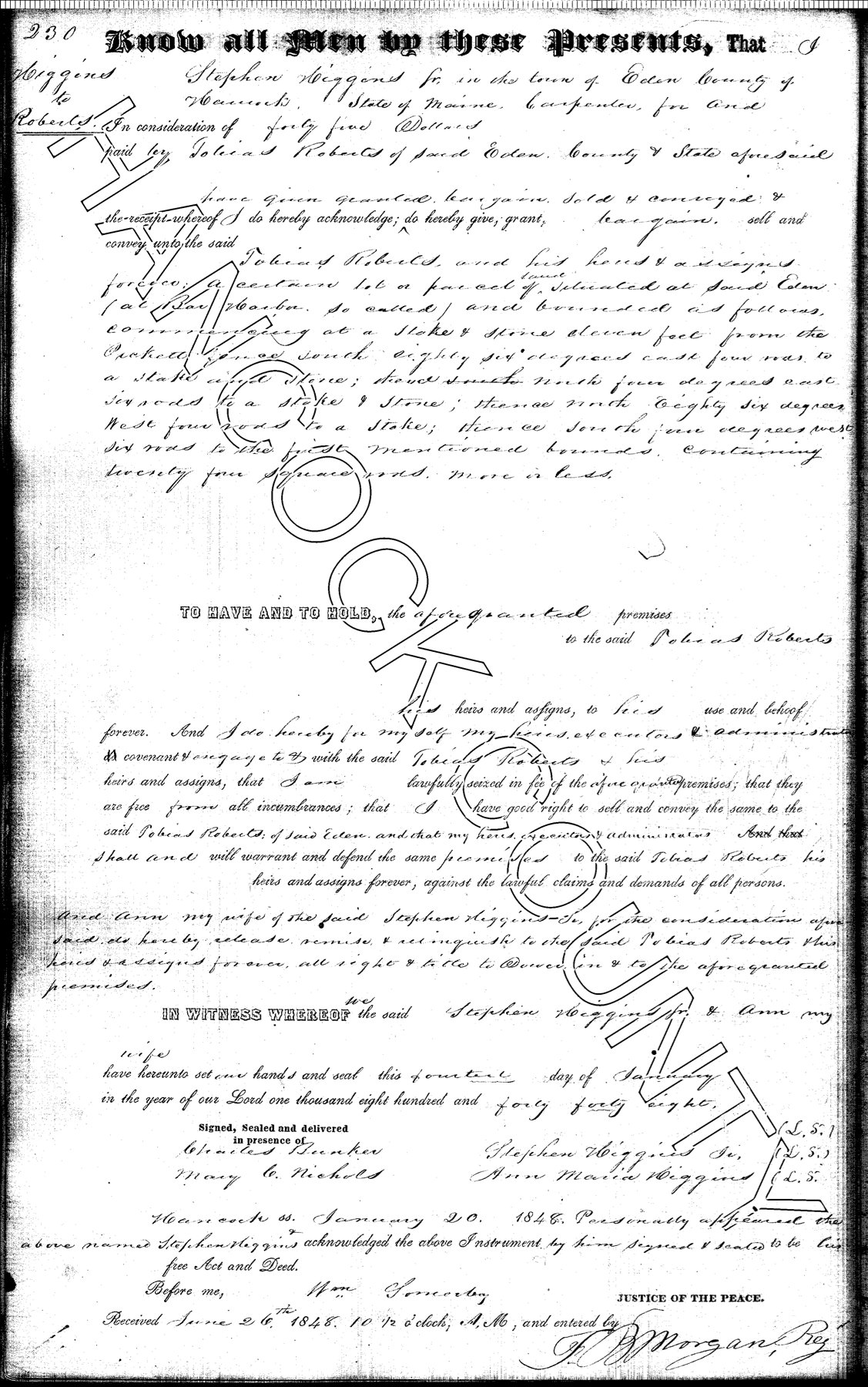
Stephen Higgins Jr.'s own parentage is not established in the records at hand. The "Jr." he used in 1848 distinguished him from the older Stephen Higgins (1771–1852), then seventy-seven, and from Capt. Stephen Higgins (1804–1862), then forty-four — both also buried in this plot. The most natural reading would make him a son of one of the two older Stephens, but the documents do not confirm it.
A third Leland sister, Huldah (1792–1882), is also buried in the plot, with her husband Henry; her connection to the founding Israel Sr. is less certain in the records than her sisters'. Henry and Huldah lost four children to the plot before her: Amos, at eleven months, in 1825; Deborah, at nineteen, in 1831; Hester, at eighteen, in 1852; and a second Deborah — named for the elder sister who had died the year before she was born — at thirty, in 1862. Huldah outlived all four of them, and her husband, by twenty years or more, dying in 1882 at the age of eighty-nine.
The next generation
Of Capt. Israel and Polly's nine children, three lived into old age. Two of them are buried in the plot beside their parents.
Capt. Stephen Higgins, born Dec. 31, 1804, followed his father to sea. He commanded full-rigged ships, including the Manto, and was preparing to retire from "a seagoing, square-rigged ship life," in A. L. Higgins's phrase, when he died of apoplexy on Sept. 4, 1862. He died on a mountain — the place the family later called "Dry Mountain" or "Flying Squadron Mountain" — and not, in spite of the anchor cut into his marker, at sea. He was fifty-seven. His daughter Mary H., born to him and his wife Margaret, whose own stone is not in this plot, is buried here; she died at twenty-one, in June 1847, the eldest grandchild of Capt. Israel Jr. and Polly Hull to be laid in this ground.
Capt. Royal Grant Higgins, born Jan. 31, 1809, also followed his father and brother to sea. He commanded full-rigged ships in his time; later he served for several years as master of a United States Coast Survey ship. He was the son who, with a "S. Higgins" — his sister, or his first wife Sarah F. Suminsby — erected the family memorial stone over their mother and over his father and brother who were never brought home. He died about 1873. He had married twice; his second wife was Mary Frances Snow (1839–1915). His daughter Ella Frances (1866–1902) and son Stephen W. (1869–1887) are buried in the plot with him, along with Mary Frances.
Sophia Higgins, born Sept. 17, 1812, married William E. Burleigh of Sanbornton, N.H. They settled first at Great Pond — now Eagle Lake — in Eden, then in Ellsworth, where William died in September 1863. Sophia outlived him by more than three decades and died at Ellsworth on Feb. 9, 1897, at the age of eighty-four. She is buried in Ellsworth.
Of the third surviving child, Warren Higgins, born February 1814, A. L. Higgins's 1931 letter records only that he "lived away from the vicinity of his old home on Mt. Desert Island."
Some seventy Higginses lie at Mount Desert Street — a concentration without parallel among the families of the cemetery. The founder of their Bar Harbor line did not come to be buried among them: Israel Sr. died at Bar Island and was laid down somewhere else. His wife Mary Snow died nine days before him, in 1818, in the same season that took their daughter-in-law Polly. The first stone set in this ground was Polly's. The man whose name is carved with hers — lost at sea five years later off Sandy Hook and never brought home — has a place in the earth only by the courtesy of his son's chisel.
Of the nine children Capt. Israel and Polly had together, four were dead by the end of 1824; two — Capt. Stephen and Capt. Royal Grant — lie nearby. The three Leland sisters from up the Leland Cove road, who married Israel's brothers Oliver, Zaccheus, and Henry, lie in the same earth as their husbands. The 200 acres at Eddy's Brook, the 100 acres next to it, the sawmill on Cromwell's Harbor Stream — none of it had been paid for in cash. Their many descendants, and the descendants of the Hulls of Hulls Cove, and the Brewers and the Suminsbys and the Stanleys and the Brookses and the Jordans, scatter through the cemetery and through the town that grew up around the farm at Eddy's Brook.